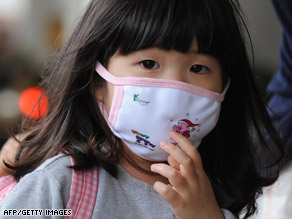
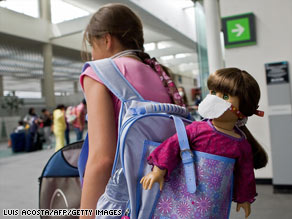
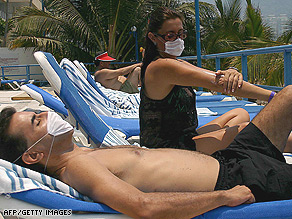
CNN has an interesting Q&A formatted article on swine flu. I was captured by the photo of a little Asian girl wearing a cute mask. The swine flu mania seems to have ended, but does this mean that swine flu isn't a serious threat anymore? People seem to easily underestimate how a pandemic could impact the world. The Spanish Flu of 1918 wiped out anywhere from 70 to 100 million people around the world. That was a true pandemic. Although we have effective antiviral therapies, many are questioning whether our supplies are adequate. If swine flu disappears over the summer, it could come back in the fall (during regular flu season) and do some serious damage. We must continue to be vigilant if we are to avoid such an outbreak of H1N1.
Thursday, May 7, 2009
Is Swine Flu No Longer a Serious Threat?
CNN has an interesting Q&A formatted article on swine flu. I was captured by the photo of a little Asian girl wearing a cute mask. The swine flu mania seems to have ended, but does this mean that swine flu isn't a serious threat anymore? People seem to easily underestimate how a pandemic could impact the world. The Spanish Flu of 1918 wiped out anywhere from 70 to 100 million people around the world. That was a true pandemic. Although we have effective antiviral therapies, many are questioning whether our supplies are adequate. If swine flu disappears over the summer, it could come back in the fall (during regular flu season) and do some serious damage. We must continue to be vigilant if we are to avoid such an outbreak of H1N1.
FDA Alert: Testosterone Gel and Children
The FDA has announced that testosterone gel that gets applied to the skin can get lead to exposure in children (also known as secondary exposure). CNN is also running a report on this story. In 2007, did you know that 1.4 million prescriptions were written for AndroGel? 25,000 of those were off-label use in women. There were 370,000 prescriptions for Testim. You don't want young children exposed to testosterone. Even a little bit can lead to sexual changes and also cause kids to exhibit more aggressive behavior (is your kid acting up these days?).
The FDA recommends the following precautions be taken to minimize the potential for secondary exposure:
- Adults who use testosterone gels should wash their hands with soap and warm water after every application;
- Adults should cover the application site with clothing once the gel has dried;
- Adults should wash the application site thoroughly with soap and warm water prior to any situation where skin-to-skin contact with another person is anticipated;
- Children and women should avoid contact with testosterone application sites on the skin of men who use these products; and
- Adults should note that use of any similar, but unapproved, products from the marketplace –including the Internet– that can result in the same serious adverse effects should be avoided.
Labels:
Androgel,
CNN,
drug safety,
FDA,
medication safety,
patient safety,
Testim,
testosterone
Medical "Smart Patch"
Would you wear a digital patch on your skin if it could help you lose weight? Let me rephrase the question. Would you be willing to wear a "smart patch" that determines your caloric intake and expenditure? How?
PhiloMetron is developing a digital "patch" that you can wear. It uses a variety of sensors, electrodes, and accelerometers (the type of technology that auto-rotates your iPhone) to calculate your caloric I's and O's (in's and out's). This information then gets transmitted via Bluetooth technology to your mobile phone. Image source: Technology Review
Labels:
bluetooth,
MIT,
mobile phone,
PhiloMetron,
Technology Review
VGX and Swine Flu Vaccines
John Gorge writes in his Philadelphia Business Journal healthcare blog about Joseph Kim. No, not me, but another Joseph Kim. Dr. J. Joseph Kim is the CEO of VGX Pharmaceuticals, a biotechnology company that uses some novel approaches to vaccine development. Dr. Kim also happens to be an MIT alumni, so we do share a few things in common. Like me, he has a strong passion for medical technology. That's what his company is about. He uses electroporation technology to develop DNA-based vaccines and it sounds like they're eager to work on a swine flu vaccine.
It sounds like VGX is merging with Inovio Biomedical Corp. of San Diego and they will operate as VGX.
Labels:
biotech,
biotechnology,
Inovio,
Joseph Kim,
MIT,
swine flu,
vaccines,
VGX,
VGX Pharmaceuticals
Avastin: New Indication for Glioma
According to Genentech, the FDA granted accelerated approval of Avastin® (bevacizumab) for people with glioblastoma with progressive disease following prior therapy. Glioblastoma (also called GBM or glioma) is the type of tumor that struck Senator Edward M. Kennedy.
Two of the key studies that led to this decision were:
- AVF3708g
- NCI 06-C-0064E
Labels:
Avastin,
bevacizumab,
brain tumors,
FDA,
FDA new drugs,
Genentech,
glioblastoma
Rethinking the Kindle DX
I've been thinking about the rationale behind the Kindle DX. Why would Amazon want to release something so large and expensive? You could purchase a mobile computer (like a laptop or netbook) for the same amount. Does it really make sense to release an e-book reader that's so expensive?
The folks over at Amazon must really think that people are willing to replace textbooks with e-books. I'm a big fan of being paperless, but that's why I use my convertible Lenovo Thinkpad X200 tablet PC. I have a large color screen (12") and I can read all the PDFs I want to without panning, scrolling, etc.
How will the Apple iPad (I call it that right now, but it could end up being called the MacPad, MacTablet or iTablet) change the way people view these portable digital devices? Many people read on their iPhone. Will a larger tablet-sized gadget be preferred? How will doctors react to this surge of slate tablet-type gadgets? Will physicians become more inclined to embrace pen-based input and move away from the keyboard? Will Microsoft Surface reinforce the fact that you can be so much more efficient if you're using natural touch and finger gestures?
The folks over at Amazon must really think that people are willing to replace textbooks with e-books. I'm a big fan of being paperless, but that's why I use my convertible Lenovo Thinkpad X200 tablet PC. I have a large color screen (12") and I can read all the PDFs I want to without panning, scrolling, etc.
How will the Apple iPad (I call it that right now, but it could end up being called the MacPad, MacTablet or iTablet) change the way people view these portable digital devices? Many people read on their iPhone. Will a larger tablet-sized gadget be preferred? How will doctors react to this surge of slate tablet-type gadgets? Will physicians become more inclined to embrace pen-based input and move away from the keyboard? Will Microsoft Surface reinforce the fact that you can be so much more efficient if you're using natural touch and finger gestures?
Labels:
Amazon,
Apple,
Apple Tablet,
e-book,
envin,
Kindle DX,
lenovo,
tablet pc,
Thinkpad,
x200 tablet
FDA Approves Fanapt (iloperidone)
The FDA has finally approved a new drug! It's about time FDA! What's going on with all these long delays? (They must be over-worked and under-staffed). Remind me never to take a government job.
The FDA has approved Fanapt (iloperidone) for the treatment of schizophrenia. Fanapt is an atypical antipsychotic and is manufactured by Patheon Inc. of Mississauga, Ontario, for Vanda Pharmaceuticals Inc., Rockville, Md.
The last atypical antipsychotic that was approved by the FDA was aripiprazole (Abilify) in 2002. Has it really been that long? I can still remember hearing the announcement about this drug like it was yesterday.
The FDA has approved Fanapt (iloperidone) for the treatment of schizophrenia. Fanapt is an atypical antipsychotic and is manufactured by Patheon Inc. of Mississauga, Ontario, for Vanda Pharmaceuticals Inc., Rockville, Md.
The last atypical antipsychotic that was approved by the FDA was aripiprazole (Abilify) in 2002. Has it really been that long? I can still remember hearing the announcement about this drug like it was yesterday.
Labels:
Fanapt,
FDA,
FDA new drugs,
iloperidone,
Patheon,
Vanda
Hazardous Drywall?
CNN has a story about a woman who was told by her doctor to vacate her house because her drywall was making her sick. Sounds a bit strange, doesn't it? Well, the drywall seems to be from China (surprise, surprise) and homes built in Florida between 2004 and 2007 may have some hazardous materials in the drywall. Here's a brief snippet from CNN:
"A study done for the Florida health department by private laboratory Unified Engineering Inc. found that samples of certain Chinese drywall gave off a sulfurous odor from "volatile sulfur compounds" when exposed to extreme heat and moisture. It also found that vapors "in the residential atmosphere created a corrosive environment in the presence of moisture."
Wednesday, May 6, 2009
Face Transplant and Microsurgery
If you haven't seen these photos yet, you have to take a look. CNN has posted some that require viewer discretion, but I'm sure you can handle these. Connie Culp had no nose because she had been shot in the face. Her cheeks and upper lip had literally been "blown away." Now, she resembles this photo - which is what she may look like in 2 years. If I ever need a face transplant, please take me to the Cleveland Clinic.
Labels:
Cleveland Clinic,
CNN,
Connie Culp,
face transplant,
microsurgery
Top Search Terms for April 2009
Here were the top search terms that brought people to this site:
- medicine and technology
- dr joe kim
- free emr
- blackberry storm medical applications
- rivaroxaban fda
- cchit 2009
- opera mini vs opera mobile
- jobs for mds without residency
- non clinical careers for doctors
Hacked: Medical Data on 8 Million Virginia Residents
Healthcare IT News reports that confidential healthcare data on 8 million Virginia residents may be compromised. Hacked! Here's a tiny excerpt:
- "The Virginia Department of Health Professions Web site has been temporarily disabled and now features a notice saying the site is "experiencing technical difficulties which affect computer and email systems." According to the department's director, Sandra Whitley Ryals, the breach is under federal investigation."
The Kindle DX is HUGE!
Medical Textbooks on the Amazon Kindle DX?
Will we see medical textbooks on the Amazon Kindle DX? Not until we see one that has a color screen (I think that's called a slate tablet PC).
How many medical students use tablet PCs during medical school? I think if I were to go back to medical school today, I would definitely use a tablet PC during my basic science courses and also during my clinical clerkships. I still remember using the Apple Newton during medical school. The Newton was killed by Apple in 1998 and that was a very sad moment for me.
Tuesday, May 5, 2009
Are You Excited about the Kindle DX?
I'm a big fan of being "green" and paperless whenever possible. We should be thinking about our environment. I read all my documents electronically. I take notes by "inking" on my tablet PC.
So, am I excited about the new Amazon Kindle DX? This thing is going to have a much larger screen. 9.7" to be exact. However, I'm willing to bet that it's also going to be priced quite high.
I love the concept of an e-book reader, but I think that the ones made by Amazon, Sony, and others are simply too expensive. If the price could come down significantly, then I think we would see a huge uptake (especially when you have celebrities like Oprah giving their endorsements).
Labels:
Amazon,
environmental health,
Kindle,
Kindle DX,
tablet pc
Second Swine Flu Death in the U.S.
CNN has reported that a second person has died in the U.S. from swine flu. According to the news, "The woman... was from Cameron County in South Texas. The Texas Department of State Health Services said the woman had "chronic underlying health conditions," but did not provide more details."
Meanwhile, New York has 90 confirmed cases. According to CNN report, the H1N1 virus is no more dangerous than seasonal flu. Has the virus mutated to the point that it's no longer very dangerous?
U.S. Homeland Security Secretary Janet Napolitano was quoted as saying: "What the epidemiologists are seeing now with this particular strain of H1N1 is that the severity of the disease, the severity of the flu -- how sick you get -- is not stronger than regular seasonal flu."
So where does this put us? Are we to treat this as a simple outbreak of seasonal flu and take off our masks? Should we be fine traveling on airplanes and visiting crowded public places? No need to quarantine any longer? Did I buy all those masks for nothing?
Meanwhile, New York has 90 confirmed cases. According to CNN report, the H1N1 virus is no more dangerous than seasonal flu. Has the virus mutated to the point that it's no longer very dangerous?
U.S. Homeland Security Secretary Janet Napolitano was quoted as saying: "What the epidemiologists are seeing now with this particular strain of H1N1 is that the severity of the disease, the severity of the flu -- how sick you get -- is not stronger than regular seasonal flu."
So where does this put us? Are we to treat this as a simple outbreak of seasonal flu and take off our masks? Should we be fine traveling on airplanes and visiting crowded public places? No need to quarantine any longer? Did I buy all those masks for nothing?
Diet Supplements and Swine Flu
There are many floating rumors about how dietary supplements may protect you from swine flu. CNN has an article, warning the public about the lack of scientific evidence to support such claims. Additionally, the FDA has already released a warning about fraudulent H1N1 products. Currently, there are only two FDA-approved products for the treatment of influenza: Tamiflu (oseltamivir) and Relenza (zanamivir). These medications are so new that I didn't even learn about these drugs in medical school.
Face Transplant Photos
Wow, this is quite an incredible story. CNN actually has photos of the first U.S. face transplant patient and they are quite remarkable (viewer discretion is advised). Click on this link to see the photos.
Connie Culp was shot in the face in 2004 and now she has a face again. Culp received the face transplant at the Cleveland Clinic and she has publicly expressed her gratitude. Medical technology has played a tremendous role in this example and I wonder what we will be capable of doing in several years. I admire her courage and wish her the best recovery.
Labels:
Cleveland Clinic,
CNN,
face transplant,
medical technology,
surgery
Would You Purchase Drugs Online?
What do you think about this concept about purchasing drugs online? How can you really trust your source? Would you buy from an online pharmacy? What if the online pharmacy was across the globe?
We live in a world where people are selling counterfeit drugs and it's becoming more and more difficult to discern the reliability of some generic manufacturers. On the flip side, because of soaring drug costs, it's becoming more difficult for patients to afford their medications here in the United States. The same drug may be much cheaper if you go to a different country. Why? That doesn't seem quite fair, does it? For instance, many generic drugs are manufactured in India. Would you feel comfortable purchasing pills directly from India? Can you trust a foreign pharmacy? Do you even need a prescription to do that? You may be surprised to know that in many other countries, you can purchase prescription medications without a prescription. Drugs like antibiotics are literally over-the-counter.
Soaring drug costs are a huge burden to our current healthcare system. New drug development costs billions of dollars. Pharmaceutical companies spend a large amount to market their drugs. As a result, new drugs are branded and no generics are available. Drug costs are high. Patients are getting desperate and resorting to unusual means. Some patients are cutting their pills in half. Others are taking their daily medications every-other-day. As a result, blood pressures are rising in those with hypertension, glucose control is worsening in patients with diabetes, and patients are ending up in the hospital.
What if Some Medical Myths Were True?
The British Medical Journal (BMJ) has several articles that attempt to dispel some common medical myths. What if some of these myths are true? What if our current limited understanding of medical science is flawed and someday we realize that we were wrong (yes, this has happened in the course of history).
So which medical myth am I thinking about today? Well, I've been thinking about the myth about hair growing back thicker if you cut it. True or myth? BMJ calls it a myth, but I'm willing to challenge that. Maybe I should submit a "letter to the editor" about that topic.
Telecommute to Avoid Swine Flu?
Top Posts for April 2009
Here were the top posts for April 2009:
Labels:
apple iphone,
cardiology,
Cardiosource,
epocrates,
non-clinical,
residency,
top posts
Congrats to the Winners Receiving the AMDIS Awards!
According to Modern Healthcare, eight winners have been chosen for the 2009 Association of Medical Directors of Information Systems (AMDIS) Awards, recognizing accomplishments advancing the application of information systems and computer technology to the practice of medicine. The winners include five individual physicians, two organizations and one team.
They are:
- Dr. Michael Dominguez, medical informatics officer, University Health System, San Antonio
- Fallon Clinic, Worcester, Mass.
- Dr. Cynthia Herzog of MemorialCare Medical Centers, Orange County, Calif.
- Kaiser Permanente, Oakland, Calif.
- Dr. Steve Margolis, chief medical informatics officer, Orlando (Fla.) Health
- Dr. Jon Morris, medical informatics officer, WellStar Health System, Marietta, Ga.
- Dr. Matt Sprunger, medical director of clinical informatics, Dupont Hospital, Fort Wayne, Ind.
- Interoperability team, University of Pittsburgh Medical Center
People with Diabetes Get All the Cool Gadgets
Does it seem like people who have diabetes end up with all the cool gadgets and gizmos? Take a look at this thing called the OmniPod PDM (Personal Diabetes Manager). Looks like a cool gadget! The handheld PDM has a large color screen and can wirelessly program your personalized insulin delivery. It also calculates suggested doses and has a convenient, built-in FreeStyle blood glucose meter. What about all those people who use Accu-Check? I suppose they can easily get accustomed to a different system since most of these glucose meters have similar functionality. People with diabetes are constantly in need of new medical supplies because they need to check their blood glucose levels.
As these diabetes devices get more sophisticated, i wonder if we will see a truely closed-loop artificial pancreas become commercialized in our lifetime. What if we could implant an artificial pancreas and cure diabetes? Wouldn't that be fantastic? Thanks to modern technology, diagnostic and self care equipment have all gotten very sophisticated and have also become easier to use. As patients get more comfortable managing their conditions, let's hope this will reduce the chronic diseases burden on the healthcare system. Image source: DiabetesMine.
Labels:
diabetes,
glucose monitoring,
OmniPod,
PDM,
Personal Diabetes Manager
MIT Targeting Tumors Using Gold Nanorods
The researchers at MIT are at it again. This time, they're using gold nanorods to target malignant tumors. It's great to see so much research in nanotechnology. The team includes an MIT graduate student named Geoffrey von Maltzahn (who won the Lemelson-MIT Student Prize, in part for his work with the nanorods). von Maltzahn developed the tumor-homing particles with Sangeeta Bhatia, MD, PhD, professor in the Harvard-MIT Division of Health Sciences and Technology (HST) and in the Department of Electrical Engineering and Computer Science, a member of the David H. Koch Institute for Integrative Cancer Research at MIT and a Howard Hughes Medical Institute Investigator.
Doctor Sangeeta Bhatia and I actually have a few things in common: we both studied mechanical engineering at MIT (I did my undergrad while she got her master's), we were both in Boston in the late nineties, and we both went to medical school (but different medical schools). Now, she holds 12 issued or pending patents and has worked in industry at Pfizer, Genetics Institute, ICI Pharmaceuticals, and Organogenesis.
Autism and the Amygdala
CNN is reporting the results of a study published in the Archives of General Psychiatry where researchers found that the amygdala was 13% larger in children with autism. Advances in medical technology are revealing new things in the science of medicine. This is absolutely fascinating, but I wonder what it means. Could this lead to a cure someday? The topic of autism has received much attention lately, especially in the area of vaccines. So many parents are afraid to vaccinate their children because they fear that vacccines may be linked to autism. As a result, this may lead to some serious public health problems if we have all these kids out there who are not vaccinated. Thankfully, herd immunity should help a bit, but it won't protect everyone. Image source: CNN
Labels:
Archives of General Psychiatry,
autism,
CNN,
psychiatry,
public health
Monday, May 4, 2009
Updates on Swine Flu
Everyone's probably getting sick (pardon the pun) of hearing about swine flu, so I'll keep this brief. The CDC chart now includes 279 cases. No new deaths. H1N1 is now in 36 states. CNN reports that swine flu is no worse than regular flu. So swine flu isn't as deadly as SARS. However, my fear is that swine flu may come back with a vengeance this fall and wipe out many people who may normally be protected by the flu vaccine. I hope and pray that this doesn't happen.
Sleep Habits and Susceptibility to the Common Cold
The Archives of Internal Medicine has an article titled, "Sleep Habits and Susceptibility to the Common Cold." This study found that "Poorer sleep efficiency and shorter sleep duration in the weeks preceding exposure to a rhinovirus were associated with lower resistance to illness."
This study evaluated 153 healthy adults who volunteered to let this happen to them: "participants were quarantined, administered nasal drops containing a rhinovirus, and monitored for the development of a clinical cold (infection in the presence of objective signs of illness) on the day before and for 5 days after exposure." I wonder how many of those 153 adults were medical students. When I was in medical school, some of my colleagues were volunteering themselves for studies that involved biopsies of their leg muscles. Medical students will volunteer for anything, won't they!
Rhinovirus causes the common cold, but I wonder what this reflects about our immune system's response to other viruses like influenza and swine flu.
Jumbo Amazon Kindle?
Rumors and floating around. Will we see a jumbo version of the Amazon Kindle? I'm still waiting for the color version.
Technology Review Digital
Technology Review is now available in an environmentally-friendly format: digital. As an MIT alum, I get this periodical for free. At one point, I used to get two copies (that's because I'm also married to an MIT alum). I think it's time for us to go green. Time to sign up for the digital version.
The most recent edition has this on the front cover: "Can Technology Save the Economy? Yes. But take a deep breath."
Sunday, May 3, 2009
CDC Lags Behind CNN
CNN is already reporting that health officials in North Carolina and Pennsylvania have confirmed the first cases of swine flu. Plus, Louisiana's governor said his state had seven confirmed cases of swine flu. These have not shown up on the CDC chart which was last updated today at 11 am Eastern.
Gregory Hartl, the WHO spokesman for epidemic and pandemic diseases, made this these comments in a briefing today (quotes appeared on CNN): "I ... would like to remind people that in 1918 the Spanish flu showed a surge in the spring, and then disappeared in the summer months, only to return in the autumn of 1918 with a vengeance... And we know that that eventually killed 40 million to 50 million people." Image source: CNN
Are Computers Helping Patients Self-Manage Their Diseases?
Most patients these days have a household computer. In fact, they may have two or three computers at home. However, do they use it for their health? Are computers making a difference in the way patients manage their chronic conditions?
Read about this interesting topic here: Health and Computers
Global Hysteria?
I've been writing about swine flu for several days and I wish to make one thing very clear: It is not my intent to increase national or global hysteria about swine flu. However, I want people to be aware of the POSSIBILITIES that may be associated with a true pandemic (which is another way of saying global epidemic).
Right now, we haven't even seen the tip of the iceberg. We're only seeing a tiny ice cube floating on the ocean. If things stay that way, then we have nothing to worry about. However, if things erupt around the world, then we'll see a massive iceberg come out of the sea.
I've been following swine flu on CNN and the latest is that there are 787 global cases of confirmed H1N1 and places like South Korea are sanitizing airports after a single identified case.
Meanwhile, the CDC is tracking the number of cases in each state. As of May 3, there are 226 cases. This means that almost 1/3 of the confirmed cases are in the USA. Why is that a big deal? Because people from all over the world travel to and from the USA. We are a major international travel hub. As the summer approaches, we will see a rise of tourists and other travelers. New York now has 63 confirmed cases. Yesterday, NY had 50. If there's one US city that attracts international tourists, it's NYC. We're already in May and schools are about to enter summer break. College students will be traveling home. We're about to see a major surge in domestic travel as well.
Anthrax was a scare, but it isn't transmitted as easily as the flu. SARS was a really big scare (especially because I knew friends living in Hong Kong), but Hong Kong isn't the type of major international travel hub like the USA.
Here in the U.S., we have a large supply of anti-viral therapies like Tamiflu (oseltamivir) and Relenza (zanamivir). Do other countries have the supply like we do? How much do these anti-viral therapies impact the course of the disease? It's probably too early to know the answer to that question. However, it may not be unreasonable to think that anti-viral therapy may be one of the reasons why mortality in the U.S. hasn't been as high as Mexico (but I don't have any scientific evidence to support that statement).
Swine Flu Discussions on Sermo
I've been following some of the swine flu discussions on Sermo. It's always interesting to hear what physicians have to say about these types of public health events. Since Sermo physicians are only US-based physicians, we don't get a global perspective. I'd really like to know what physicians in other countries are saying right now about swine flu. My guess is that they're telling all their patients to avoid travel to the U.S.
On Sermo, you'll find something called the "Sermo Swine Influenza Central." You have to be a US-based physician to join Sermo, but since it's free to join, why don't you?
Saturday, May 2, 2009
Missing Guests at Hong Kong Swine Flu Hotel
I love the city of Hong Kong. There are not that many cities in the world that has the digital infrastructre that's seen in Hong Kong. Kowloon Bay at nigth is amazing. Well, enough about Hong Kong.
If this story (Missing Guests at Hong Kong Swine Flu Hotel) is true, then this is truly embarrassing. A hotel in Hong Kong is being quarantined because a guest was positive for H1N1. However, people have somehow escaped this quarantine and now officials are looking for these 50 people who never returned to their hotel. Meanwhile, 10 passengers who sat near the young Mexican passenger on China Eastern Airlines flight MU 505 from Shanghai and the two cab drivers who drove him around town have been located and their cases are being investigated, according to Thomas Tsang, controller of the Centre for Health Protection.
Why is a swine flu pandemic eminent? Because it's so difficult to enforce quarantine.
If this story (Missing Guests at Hong Kong Swine Flu Hotel) is true, then this is truly embarrassing. A hotel in Hong Kong is being quarantined because a guest was positive for H1N1. However, people have somehow escaped this quarantine and now officials are looking for these 50 people who never returned to their hotel. Meanwhile, 10 passengers who sat near the young Mexican passenger on China Eastern Airlines flight MU 505 from Shanghai and the two cab drivers who drove him around town have been located and their cases are being investigated, according to Thomas Tsang, controller of the Centre for Health Protection.
Why is a swine flu pandemic eminent? Because it's so difficult to enforce quarantine.
Is Swine Flu in Your State?
Have you seen the CDC chart that's tracking swine flu? People may think that the highest number of confirmed cases are in Texas. Wrong! New York already has 50 confirmed cases (as of May 2 at 11 am ET). Texas has 28 and California has 24. H1N1 is spreading rapidly. Every state that has a major metropolitan area will be on this chart within the next several days.

To view this scary chart, go here: http://www.cdc.gov/h1n1flu/
Image source: CDC
AAN in Seattle is Over
The AAN (American Academy of Neurology) meeting ended in Seattle today. These types of meetings generally draw physicians and other healthcare professionals from all over the world. Now that the news about swine flu has spread globally, I wonder what these physicians will encounter when they return to their native countries. I hope they don't get quarantined at the first sign of a sneeze! Modern technology has made it so easy to travel these days. In turn, it's now so easy to spread germs across the globe.
Labels:
AAN,
American Academy of Neurology,
Seattle,
swine flu
Should We Really Be Worried About Swine Flu?
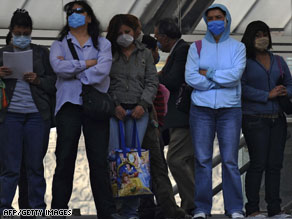
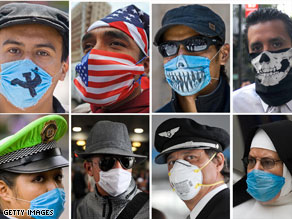
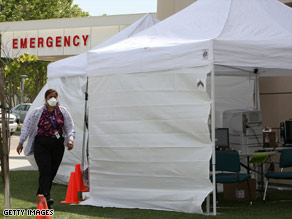
According to CNN, ERs are getting flooded with patients who think they may have swine flu. Overcrowding problems have forced some hospitals to set up tents outside for patients. We see people wearing masks everywhere. Are people overreacting? Are we in a panic mode?
Some may argue that swine flu really isn't a big deal. After all, 5% to 20% of U.S. residents get the flu, and more than 200,000 persons are hospitalized for flu-related complications each year. About 36,000 Americans die on average per year from the complications of the regular flu, so what's the big deal about swine flu, right? Let's take things into proper perspective here.
H1N1 - Mexico has reported 397 confirmed human cases of infection, including 16 deaths. We know that these numbers only reflect confirmed cases, so there are many more who are simply "unconfirmed" at this point.
Mexico's death rate is 4.0%. At this rate, if 15 million people get infected, 600,000 people could die and if 60 million people get infected, 2.4 million people could die. Compare that to the 36,000 deaths from the regular flu. Should we be worried about swine flu? I'm afraid that we have to be very concerned. Image source: CNN
First Case of Swine Flu in South Korea
If you live around many Asians, you probably know that Kim is a very common last name for Koreans. In fact, it's the most common last name in Korea. Speaking of Korea, CNN reports that the first reported case of swine flu in South Korea has occurred. We don't have a name, but the person is a 51-year-old nun who recently traveled to Mexico for volunteer work.
Swine flu has also hit China. A hotel in Hong Kong has been quarantined because a guest was found to be infected with swine flu.
So should we be worried? We should definitely be concerned and I think we also have to seriously consider the strong possibility that a pandemic will occur. Image source: CNN
Face Masks at Home Depot
I went to my local Home Depot today because I had to do some home improvement. Out of curiosity, I walked by the isle that had face masks. Plenty in stock! I'm glad that people here aren't in panic about the swine flu. However, I wonder what stores in Texas must be going through.
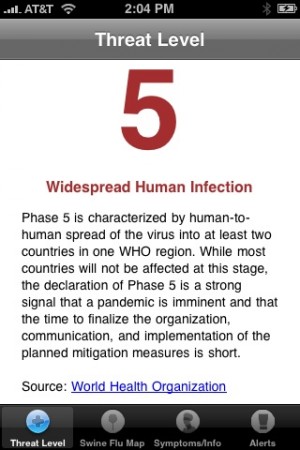
CNN reports that the number of confirmed swine flu cases is now up to 658. The leaders at the WHO feel that a pandemic is eminent and I wouldn't be surprised if we reach Phase 6 soon. We're already at Phase 5, so it's only a matter of time as this virus spreads globally.
Labels:
CNN,
epidemic,
pandemic,
public health,
swine flu,
WHO,
World Health Organization
Swine Flu iPhone Tracker
Labels:
Apple,
apple iphone,
iphone,
ipod touch,
mobile technology,
pandemic,
SARS,
swine flu
Friday, May 1, 2009
A Swine Flu Guide for Parents?
If you're a parent, do you feel that you need a swine flu guide? Aren't we just talking about common sense? CNN has a story about the parent guide and here's the bottom line:
- No. 1 on the list: washing hands more frequently.
CDC and the H1N1
The CDC (Centers for Disease Control and Prevention) has released something titled, "Interim Guidance on Antiviral Recommendations for Patients with Confirmed or Suspected Swine Influenza A (H1N1) Virus Infection and Close Contacts."
If you're a healthcare professional who may be involved in the treatment of someone who has swine flu (or suspected swine flu), then you should read this and stay abreast on any updates the CDC releases. The misuse of antiviral therapies may lead to all sorts of problems ranging from drug shortages, drug resistance, and unnecessary adverse effects.
The AMA Created a Page on Swine Flu
The AMA (American Medical Association) has created an information page on swine flu. Get to it here: http://bit.ly/nf52P
Another FDA Alert: Fraudulent Swine Flu Products
The FDA has released another alert: FDA, FTC Warn Public of Fraudulent 2009 H1N1 Influenza Products
Isn't that such a shame that people would try to take advantage of this situation? As more misinformation appears on the Internet, these types of scams and fraudulent activity may rise. People will provide their "testimonials" about how well these things work and these types of stories will appear on blogs, Twitter, and other social networking sites. Don't fall for these scams! Always check with your healthcare provider before you go out and invest in anything you see on the Internet.
Dangers of Online Social Networking
I remember when AOL came out with their "Instant Messaging" application. It was a huge hit and people didn't realize that instant messaging had been available through other services. ICQ came out in 1996 and AOL's IM came out in 1997. Wow, was that over 10 years ago? Did people even have computers back then?
There are some serious public health implications associated with online social networking. I've been reflecting on this topic as I've immersed myself in the Twitter community. It's so easy to meet complete strangers and to fall prey into fraudulent schemes. If you're not careful, you could lose money or have your identity stolen. People may also experience physical harm if they disclose too much information to social predators and other dangerous people. There's absolutely no way to know who's typing on the other end of that message you receive.
Recently, a fraudulent website was trying to lure Facebook users into providing personal information, including passwords. This type of schemes are becoming so common and there are still many people who don't know how to differentiate a valid website from a phishing site. We must educate the public about safe practices when it comes to online social networking.
There are some serious public health implications associated with online social networking. I've been reflecting on this topic as I've immersed myself in the Twitter community. It's so easy to meet complete strangers and to fall prey into fraudulent schemes. If you're not careful, you could lose money or have your identity stolen. People may also experience physical harm if they disclose too much information to social predators and other dangerous people. There's absolutely no way to know who's typing on the other end of that message you receive.
Recently, a fraudulent website was trying to lure Facebook users into providing personal information, including passwords. This type of schemes are becoming so common and there are still many people who don't know how to differentiate a valid website from a phishing site. We must educate the public about safe practices when it comes to online social networking.
2 FDA Alerts: Hydroxycut and Botox
The FDA has recently released two different (unrelated) alerts:
- Botox - now has safety label changes, a boxed warning, and a Risk Evaluation and Mitigation Strategy (REMS).
- Hydroxycut - stop using any hydroxycut products by Iovate Health Sciences because of serious health problems.
Follow Friday on Twitter is Today
People Not Taking Swine Flu Seriously
It's incredible. People are still out in public in areas that have widespread infection of swine flu. CNN now reports that we're up to 331 confirmed cases. I suspect these numbers will grow exponentially as swine flu spreads like the common cold. I think many people aren't taking this very seriously and they don't realize the public health implications behind this spreading infection. It's scary to think what the numbers will look like next week.
Labels:
epidemic,
infection,
infectious diseases,
outbreak,
pandemic,
public health,
swine flu
Tunstall Gets FDA Clearance for Wireless Telehealth Monitor With Built-in GSM/GPRS
Mobile technology has taken home monitoring to an entirely new level. The company Tunstall has received FDA 510(k) clearance to market wireless telehealth monitor with built-in GSM/GPRS technology. The device is called the RTX3371. It collects data from various home monitoring devices (like blood pressure cuffs, weight scales, etc.) and then transmits that data wirelessly to your healthcare provider. It can even talk to you! So, if you want to keep an eye on your patient's weight at home, this may be the device to get. Hopefully, as we see more of these types of medical devices emerge, the self-management of chronic conditions will improve. These are some exciting developments in the world of medicine and technology!
Labels:
FDA,
home monitoring,
medical devices,
Medicine and Technology,
RTX3371,
Tunstall
Doctors Need Education About Swine Flu
Medical students don't usually learn about swine flu in medical school. How are doctors learning about the appropriate management of infected individuals? Are they delivering the best type of care if they don't know where to do their research? I don't know of any continuing medical education (CME) activity that covers the topic of swine flu. Will they simply rely on common sense and their own personal experience? My hope is that healthcare professionals will leverage the use of mobile technology to learn and to educate patients about swine flu. Otherwise, we'll be reading things on CNN and learning from our mistakes.
Labels:
cme,
continuing medical education,
education,
swine flu
Subscribe to:
Posts (Atom)