Here's an interesting lecture from MIT World by Hidde Ploegh, PhD, Professor of Biology, MIT; Member, Whitehead Institute.
In his role as a biochemist, Hidde Ploegh explains the "essential features of the lifestyle of the flu virus" discussing not only how viruses work to invade our systems and cause the flu, but also adding insights into the political and societal framework in which public health groups and governments deal viral disease.

Showing posts with label flu. Show all posts
Showing posts with label flu. Show all posts
Wednesday, January 13, 2010


Friday, December 11, 2009
Will we see a second wave of H1N1 this winter?

It may seem like the H1N1 pandemic has spread through your community. My wife had confirmed H1N1 last month. Many schools in our area closed because of the pandemic in November. Yet it's only mid-December and we know that the flu season can easily go beyond February. So, will we see a second wave of H1N1 later this winter? What about the early spring?
Experts are definitely concerned about that possibility and many are evaluating historical data, exploring computer models, and looking at other ways to predict what may happen this winter. The bottom line is that no one really knows what will happen. However, if we see a second wave, what will that look like now that many people have already been exposed and have (theoretically) developed immunity to H1N1. Will the virus mutate to the point that it will cause reinfection in those who have already been vaccinated?
There are still so many unanswered questions about H1N1. We must continue to practice proper hygiene and common sense so that we reduce the spread of viral infections this winter. That's going to be difficult since December is a busy month for stores, malls, etc. How often will you be going to a crowded place filled with potentially sick people?
Friday, November 13, 2009
AMAfluhelp.org for professionals and consumers
 Remember that AMAfluhelp.org is available as an online resource for both health care professionals and consumers (patients). AMAfluhelp.org features some great web-based tools and resources.
Are you a patient? Some of the many features and benefits for Patients include:
• Health Sessions - A directory of Health Session Programs offers you a variety of personalized, condition-specific health and wellness programs authored by expert health professionals. These Health Sessions are delivered on a scheduled basis and consist of a brief set of questions and answers, educational information specific to the symptoms, vital signs, medication issues related to your health conditions and goals. Based on your answers, you receive immediate feedback and expert guidance.Are you a health care professional? Important features and functions of AMAFluHelp.org for healthcare professionals include:
• Health Team - This Feature allows you to invite family caregivers, friends, and/or your doctor and other health professionals to join your health team. Upon accepting your invitation, members of your Health team can receive secure reports and notifications generated from your health sessions.
• Health Team Messages Center - Your Health Team members can better communicate through a secure message board that allows you, your family caregivers, and the health professionals involved in your care to post notes and recommendations that will assure better coordination of care. Recommendations generated by each completed Health Session are also posted to the message board for your Health Team to review.
• Personal Health Record - Through connectivity with Microsoft® HealthVault™, you can get your latest medication list, receive lab results and immunization records electronically, store x-rays, and EKGs. You can also upload, store, and graph measurements from home blood pressure monitors, glucose meters, and other devices.
• Session Alerts Dashboard - This exception-management triage tool makes it easy to identify which Patients need the most attention according to the rules logic algorithm built into the Health Session Program(s). The dashboard is a customizable tabular viewer, consisting of rows and columns. Each row displays the responses from each patient Health Session by date in a green-yellow-red color-coded alert criteria. These responses are divided into columns representing various question types including symptoms, vital signs, medications, behavior, knowledge and others. The dashboard gives Healthcare Professionals the ability to monitor and manage up to 2,000 Patients who have granted access to their records via the Health Team invitation.Visit AMAfluhelp.org
• Patient Record - Double-clicking on any patient row in the Session Alerts Dashboard will show an entire patient record, including their detailed Health Session responses, medication list, vital signs, alerts summary, and patient notes, and listing of the Patient Health Team members and message center.
• Health Team Message Center - Members of the Patient’s Health Team can communicate through a secure message board that allows the health professionals, you, your family caregivers, and involved in your care to post notes and recommendations that will improve coordination of care. Recommendations generated from completed Health Session are also posted to the Message Board and made available to the Health Team.
Tuesday, November 10, 2009
FDA Commissioner's letter to health care professionals about H1N1 vaccine

The FDA Commissioner Margaret A. Hamburg, M.D. recently wrote a letter to health care professionals about the H1N1 vaccine. It's actually a very descriptive letter of how the H1N1 vaccine was developed. She concludes by focusing on vaccine safety and the reporting of adverse events. Here's a snippet:
I encourage you to report any adverse effects that you believe are linked to any vaccine, including the 2009 H1N1 influenza vaccine, to the Vaccine Adverse Event Reporting System (http://vaers.hhs.gov/index). Other resources for 2009 H1N1 influenza, including a detailed description of vaccine safety efforts, are online at www.flu.govI agree with Dr. Hamburg that most U.S. families will be touched (directly or indirectly) by H1N1. You probably know many families by now. Maybe you've been affected by H1N1. It's only November and it's hard to predict what to expect for the rest of the winter, but make sure to protect yourself and your family by washing your hands.
Friday, October 23, 2009
AMAFluHelp.org
As you may have guessed, the AMA (American Medical Association) has launched this website to provide educational content regarding the seasonal flu and H1N1. This educational content is available to consumers (or patients) and also to health care professionals.
Upon establishing a free account, you can subscribe to personalized, interactive Health Session Programs that have been authored by the AMA for patients and their families. These programs include:
- Child Assessment: H1N1 flu and children under 18
- Am I high risk for H1N1 and need the vaccine?
- Adult Self Assessment: Do you have H1N1 flu?
- H1N1 Post Vaccine Monitoring
- Pregnancy: Do you need the H1N1 flu vaccine?
- H1N1 Flu: Can I return to school or work?
Friday, June 26, 2009
U.S. swine flu - 1 million?
According to Time.com, the U.S. may have hit 1 million swine flu cases. Lyn Finelli, a flu surveillance official with the Centers for Disease Control and Prevention (CDC), made the 1 million estimate in a presentation to a vaccine panel in Atlanta. The number is based on mathematical modeling that uses data from surveys by health officials.
The United States has roughly half the world's swine flu cases, with nearly 28,000 reported to the CDC so far. The U.S. count includes 3,065 hospitalizations and 127 deaths. Here are some interesting stats: The average age of swine flu patients is 12, the average age for hospitalized patients is 20, and for people who died, it was 37. It seems to be deadliest to people 65 and older, with deaths in more than 2 percent of elderly people infected.
So, do you think more people will be getting the flu vaccine this year? I'm willing to bet that people who normally don't get the flu vaccine will definitely want to get it this year. It's possible that the swine flu vaccine may be given in two separate doses, 21 days apart. To read the full story at Time.com, click here.
Sunday, May 17, 2009
H1N1 Around the World

H1N1 may not be a pandemic, but it has reached the ends of the earth. Take a look at this WHO (World Health Organization) map!
As of today (May 17), 39 countries have officially reported 8480 cases of H1N1 infection. Swine flu has spread very rapidly to many countries. Had the virus been more virulent and lethal, could we have had a pandemic? Could a pandemic still occur this fall/winter during the regular flu season? I hope that H1N1 won't go down in the history books like the Spanish Flu.
Monday, May 4, 2009
Sleep Habits and Susceptibility to the Common Cold

The Archives of Internal Medicine has an article titled, "Sleep Habits and Susceptibility to the Common Cold." This study found that "Poorer sleep efficiency and shorter sleep duration in the weeks preceding exposure to a rhinovirus were associated with lower resistance to illness."
This study evaluated 153 healthy adults who volunteered to let this happen to them: "participants were quarantined, administered nasal drops containing a rhinovirus, and monitored for the development of a clinical cold (infection in the presence of objective signs of illness) on the day before and for 5 days after exposure." I wonder how many of those 153 adults were medical students. When I was in medical school, some of my colleagues were volunteering themselves for studies that involved biopsies of their leg muscles. Medical students will volunteer for anything, won't they!
Rhinovirus causes the common cold, but I wonder what this reflects about our immune system's response to other viruses like influenza and swine flu.
Thursday, April 30, 2009
Swine Flu on the Rise
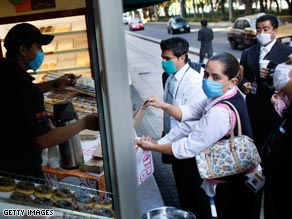
Everyone's talking about swine flu. However, it's a very serious topic, especially since it's on the rise. According to CNN, there have been 236 confirmed cases worldwide. This means that there are probably many more (since you can't confirm all the cases that are out there), but if you think about how easy it is to spread the cold or the flu, then you can imagine how quickly this things is spreading. This is very alarming. How do you communicate a public health message without causing global panic? Image source: CNN
Sunday, April 26, 2009
Swine Flu: Public Health Emergency

Swine flu is getting really serious. If you live in Texas, you need to on alert. According to CNN, he federal government has declared a public health emergency because of the increasing number of cases in the USA. More people are wearing masks to protect themselves and people in Mexico are being told not to kiss because of the possibility of infection. Over 80 people have died in Mexico from swine flu. The H1N1 strain is usually only found in pigs, but it's somehow managed to infect humans. We heard quite a bit about bird flu and the H5N1 virus a few years ago, and now in 2009 the big fear will be swine flu. We may still hear about bird flu this year.
There are now 20 confirmed cases of swine flu in this country. Swine flu essentially mimics other viral infections that cause the flu, so it's difficult to differentiate this infection from a common cold or flu. Let's hope and pray this gets controlled quickly.
Subscribe to:
Posts (Atom)