Showing posts with label World Health Organization. Show all posts

Tuesday, December 1, 2009

World AIDS Day


Today is December 1 and is World AIDS Day. Here are some staggering statistics:
  • More than two million AIDS related deaths reported globally in 2008 - two million children under the age of 15 now live with HIV.
  • New figures released by the World Health Organization and UNAIDS estimate the number of new HIV infections have declined each year by about 17% from 2001 to 2008, but for every five people infected, only two start treatment.
The World AIDS Campaign is a global coalition of national, regional and international civil society groups united by the call for governments to honor their AIDS commitments under the slogan “Stop AIDS. Keep the Promise.” The campaign is governed by a steering committee of global constituency-based networks and supported by a team of support staff based primarily in Cape Town, South Africa and partially in Amsterdam, The Netherlands.

To learn more about World AIDS Day and the World AIDS Campaign, visit: http://www.worldaidscampaign.org

Friday, November 13, 2009

GSK donating 50 million H1N1 vaccine doses to the WHO


GSK (GlaxoSmithKline) is donating 50 million doses of H1N1 vaccine to the WHO (World Health Organization). These vaccines will be sent to developing countries that lack significant medical resources.

Here in the United States, we readily have access to antiviral medications and modern hospital facilities. That's not the case in most developing nations. As a result, the H1N1 pandemic may result in significant higher mortality in these countries. I'm glad to see pharmaceutical companies donating and contributing to global public health issues like this current H1N1 pandemic.

Thursday, November 5, 2009

Another study looking at cell phones and brain cancer


I don't think we'll ever see the end of this debate. Do cell phones emit enough radiation to contribute to brain tumors and cancer? Specifically, people are concerned about glioblastoma. Mobile phone companies and carriers will probably do everything to convince the world that the answer is "no." Activist groups and cancer patients will do everything to convince the world the answer is "yes." Meanwhile, we as health care professionals will probably shrug our shoulders and say, "we really don't know."

The Interphone study overseen by the World Health Organization may be one of the largest studies evaluating the association between cell phone use and brain tumors. Here's a quote from The Daily Telegraph :
A preliminary breakdown of the results found a “significantly increased risk” of some brain tumours “related to use of mobile phones for a period of 10 years or more” in some studies.
Now, keep in mind that phones have evolved dramatically and that older analog phones emitted higher levels of compared to modern digital phones (although smartphones and high bandwidth data plans are a different story).

To get a preview of some of the results from this study, click here.

Wednesday, August 5, 2009

Swine flu deaths around the world exceeding 1,100


According to this CNN story, the World Health Organization is reporting that global swine flu deaths are exceeding 1,100. We know that H1N1 is an unstoppable pandemic. This virus has spread in six weeks like how the common flu virus spreads in six months! We're waiting for effective vaccines and I'm sure we'll see them. The question in my mind is: will we have enough vaccines?

So who should get the vaccine?
The priority groups include pregnant women, health care and emergency services personnel, children, adolescents and young adults from six months to 24 years of age, household and caregiver contacts of children younger than six months and healthy adults with certain medical conditions.
Even though there are strong public health campaigns to get people vaccinated, we know that some simply won't receive the vaccine. Either they will refuse it, or they won't have access to medical care. Some won't make it a priority and they won't get the swine flu vaccine in time. Will we have enough anti-viral therapies for all those who don't receive a vaccine?

Friday, June 12, 2009

Almost 30,000 Confirmed Cases of Swine Flu


CNN is reporting that we have almost 30,000 confirmed cases of swine flu (H1N1) around the world. The World Health Organization (WHO) says that swine flu can't be stopped and that it's a pandemic. H1N1 has already reached over 70 countries and thing are going to get worse this fall and winter when the regular flu season hits. Will we see a safe and effective vaccine hit the market before this happens?

The swine flu pandemic is the first flu pandemic in the 21st century. Things today are very different compared to the Spanish flu pandemic of 1918. Considering the amount of international travel that occurs these days, it's no wonder that swine flu spread so quickly. How will this impact your summer travel plans?

Thursday, June 11, 2009

WHO has Declared Swine Flu a Global Pandemic

As of today (June 11), the WHO (World Health Organization) has officially declared swine flu to be a global pandemic. Read more at CNN.

We are now at phase 6, the pandemic phase with H1N1. Although swine flu has spread around the world, the key question now lies in the severity of swine flu. This is from the WHO website: "At this time, WHO considers the overall severity of the influenza pandemic to be moderate... The severity of pandemics can change over time and differ by location or population. "

Sunday, May 17, 2009

H1N1 Around the World


H1N1 may not be a pandemic, but it has reached the ends of the earth. Take a look at this WHO (World Health Organization) map!

As of today (May 17), 39 countries have officially reported 8480 cases of H1N1 infection. Swine flu has spread very rapidly to many countries. Had the virus been more virulent and lethal, could we have had a pandemic? Could a pandemic still occur this fall/winter during the regular flu season? I hope that H1N1 won't go down in the history books like the Spanish Flu.

Sunday, May 3, 2009

Global Hysteria?


I've been writing about swine flu for several days and I wish to make one thing very clear: It is not my intent to increase national or global hysteria about swine flu. However, I want people to be aware of the POSSIBILITIES that may be associated with a true pandemic (which is another way of saying global epidemic).

Right now, we haven't even seen the tip of the iceberg. We're only seeing a tiny ice cube floating on the ocean. If things stay that way, then we have nothing to worry about. However, if things erupt around the world, then we'll see a massive iceberg come out of the sea.

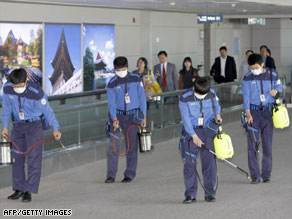
I've been following swine flu on CNN and the latest is that there are 787 global cases of confirmed H1N1 and places like South Korea are sanitizing airports after a single identified case.

Meanwhile, the CDC is tracking the number of cases in each state. As of May 3, there are 226 cases. This means that almost 1/3 of the confirmed cases are in the USA. Why is that a big deal? Because people from all over the world travel to and from the USA. We are a major international travel hub. As the summer approaches, we will see a rise of tourists and other travelers. New York now has 63 confirmed cases. Yesterday, NY had 50. If there's one US city that attracts international tourists, it's NYC. We're already in May and schools are about to enter summer break. College students will be traveling home. We're about to see a major surge in domestic travel as well.

Anthrax was a scare, but it isn't transmitted as easily as the flu. SARS was a really big scare (especially because I knew friends living in Hong Kong), but Hong Kong isn't the type of major international travel hub like the USA.

Here in the U.S., we have a large supply of anti-viral therapies like Tamiflu (oseltamivir) and Relenza (zanamivir). Do other countries have the supply like we do? How much do these anti-viral therapies impact the course of the disease? It's probably too early to know the answer to that question. However, it may not be unreasonable to think that anti-viral therapy may be one of the reasons why mortality in the U.S. hasn't been as high as Mexico (but I don't have any scientific evidence to support that statement).

Saturday, May 2, 2009

Face Masks at Home Depot


I went to my local Home Depot today because I had to do some home improvement. Out of curiosity, I walked by the isle that had face masks. Plenty in stock! I'm glad that people here aren't in panic about the swine flu. However, I wonder what stores in Texas must be going through.

CNN reports that the number of confirmed swine flu cases is now up to 658. The leaders at the WHO feel that a pandemic is eminent and I wouldn't be surprised if we reach Phase 6 soon. We're already at Phase 5, so it's only a matter of time as this virus spreads globally.

Wednesday, April 29, 2009

WHO Raises Pandemic Alert to Phase 5

Swine flu is becoming a very serious public health problem. The World Health Organization (WHO) is raising the pandemic alert to phase 5 (and phase 6 is the highest level).

"Phase 5 is characterized by human-to-human spread of the virus into at least two countries in one WHO region. While most countries will not be affected at this stage, the declaration of Phase 5 is a strong signal that a pandemic is imminent and that the time to finalize the organization, communication, and implementation of the planned mitigation measures is short."

Let's hope we don't reach phase 6:

"Phase 6, the pandemic phase, is characterized by community level outbreaks in at least one other country in a different WHO region in addition to the criteria defined in Phase 5. Designation of this phase will indicate that a global pandemic is under way."

Tuesday, April 28, 2009

Do Masks Really Protect You from Swine Flu?


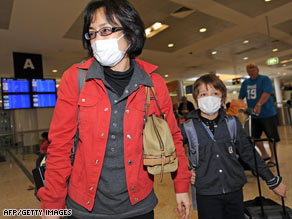
We're going to run out of masks. You better go to Home Depot and stock up now. Do masks really protect us from swine flu or are people just being paranoid? CNN has a story about this and it captured my attention. What would your workplace look like if everyone was wearing a mask? What if you entered a bank wearing a hat and a mask? You might be on the ground pretty quickly. So what's the role of a mask during a viral epidemic? According to the WHO, it's primarily to prevent infected people from spreading their germs. So if you're wearing a mask, people may think you're infected!

Should we be carrying antibacterial wipes and gel instead? After all, handwashing is the most effective way to prevent any type of viral infection since our hands can get contaminated very easily. Before we know it, we're rubbing our eyes or eating something with our dirty hands. Image source: CNN