Join colleagues to experience the official LIVE broadcast of CDC’s newest virtual event - The 2012 Centers of Excellence Public Health Informatics Virtual Symposium, accessible on June 26th, 2012 at 1:00 pm eastern. This virtual meeting will feature exclusive content around the theme of Population Health Decision Support and The Centers of Excellence in Public Health Informatics.
Register and log in here for FREE to access this online event in an exclusive, immersive environment and experience the latest developments in public health informatics.
Learn more about this event here.
Showing posts with label Centers for Disease Control and Prevention. Show all posts
Monday, June 18, 2012
Tuesday, December 15, 2009
800,000 H1N1 vaccine doses recalled
It's no surprise that we're already seeing a recall of 800,000 H1N1 vaccines. Fortunately, this recall isn't due to any safety concerns. Rather, this recall is occurring because the vaccine doses are not considered "potent" as they should be. According to CNN:
The French manufacturer Sanofi Pasteur is voluntarily recalling about 800,000 doses of vaccine meant for children between the ages of 6 months and 35 months... The CDC emphasized that there is no danger for any child who received this type of vaccine... When asked what parents should do, CDC spokesman Tom Skinner said, "absolutely nothing." He said if children receive this vaccine, they will be fine.So, if your child got the vaccine, you don't need to do anything. To learn more about this recall, visit the CDC website.
Wednesday, September 9, 2009
Remember Fetal Alcohol Syndrome today (9/9/09)
Today is a unique day on the calendar that only happens once: 9/9/09
Since pregnancy is 9 months, remember Fetal Alcohol Syndrome (FAS) on this day. That's what the Minnesota Organization on Fetal Alcohol Syndrome (MOFAS) is doing today. This date was chosen to represent 9 months of no alcohol for women who are considering pregnancy.
Many people have misconceptions regarding alcohol and pregnancy. For instance, some people think that alcohol-related birth defects only occur if you drink alcohol heavily during your pregnancy. The fact is that many defects (including developmental problems) can occur even if you only drink very small amounts of alcohol during pregnancy.
The CDC (Centers for Disease Control and Prevention) has a website that provides additional information about Fetal Alcohol Spectrum Disorders (FASDs). FASDs are 100% preventable if a woman does not drink alcohol during pregnancy.
Monday, July 27, 2009
Camp Twitch and Shout
I love summer camps. However, "Camp Twitch and Shout" is not your typical summer camp. This is a camp for people who have Tourette syndrome (according to Wikipedia is also called Tourette's syndrome, Tourette's disorder, Gilles de la Tourette syndrome, GTS or, more commonly, simply Tourette's or TS). It's a neurological disorder characterized by motor and voice tics.
According to the Centers for Disease Control and Prevention, three out of every 1,000 school-age children are believed to have Tourette syndrome. The cause is unknown, but genetics appear to play a role. Most children develop the condition between 7 and 10, and if their tics are mild to moderate, they usually require no medicine to control them. Symptoms usually peak during the late teens or early 20s.What goes on at Camp Twitch and Shout? Children with Tourette's get to have fun. It's so great to see social support groups like these camps. We have CaringBridge and other online social support sites for people who are struggling with various health conditions. When you get to meet at a camp, interact, and have fun, then I'm sure some unique friendships develop. Click here for the CNN story.
Saturday, July 11, 2009
National Environmental Public Health Tracking Network
The CDC (Centers for Disease Control and Prevention) has recently launched a new website: the National Environmental Public Health Tracking Network.
Environmental public health tracking is a type of surveillance. It is a way of incorporating data for analysis and reporting. CDC's National Environmental Public Health Tracking Network is a website that brings together data concerning some health and environmental problems. The goal of this network is to provide information to help improve where we live, work, and play. The Tracking Network is part of CDC's National Environmental Public Tracking Program.The Tracking Network provides information about the following types of data:
- Health effect data: Data about health conditions and diseases, such as asthma and birth defects.
- Environmental hazard data: Data about chemicals or other substances such as carbon monoxide and air pollution in the environment.
- Exposure data: Data about the amount of a chemical in a person's body, such as lead in blood.
- Other data: Data that helps us learn about relationships between exposures and health effects. For example, information about age, sex, race, and behavior or lifestyle choices that may help us understand why a person has a particular health problem.
Friday, July 3, 2009
E. coli in beef leading to hospitalizations
MSNBC is reporting that at least 12 hospitalizations have occurred due to E. coli contamination in beef. Some of these patients have even suffered kidney failure. According to the Centers for Disease Control and Prevention (CDC), at least 23 people in nine states may have become ill after eating beef produced by JBS Swift Beef Co. of Greeley, Colo. I think it's time to make sure my beef is cooked well-done for a while. Forget eating medium-rare or even medium steaks. To read the full story on MSNBC, click here.
Monday, May 4, 2009
Updates on Swine Flu
Everyone's probably getting sick (pardon the pun) of hearing about swine flu, so I'll keep this brief. The CDC chart now includes 279 cases. No new deaths. H1N1 is now in 36 states. CNN reports that swine flu is no worse than regular flu. So swine flu isn't as deadly as SARS. However, my fear is that swine flu may come back with a vengeance this fall and wipe out many people who may normally be protected by the flu vaccine. I hope and pray that this doesn't happen.
Sunday, May 3, 2009
CDC Lags Behind CNN
CNN is already reporting that health officials in North Carolina and Pennsylvania have confirmed the first cases of swine flu. Plus, Louisiana's governor said his state had seven confirmed cases of swine flu. These have not shown up on the CDC chart which was last updated today at 11 am Eastern.
Gregory Hartl, the WHO spokesman for epidemic and pandemic diseases, made this these comments in a briefing today (quotes appeared on CNN): "I ... would like to remind people that in 1918 the Spanish flu showed a surge in the spring, and then disappeared in the summer months, only to return in the autumn of 1918 with a vengeance... And we know that that eventually killed 40 million to 50 million people." Image source: CNN
Global Hysteria?
I've been writing about swine flu for several days and I wish to make one thing very clear: It is not my intent to increase national or global hysteria about swine flu. However, I want people to be aware of the POSSIBILITIES that may be associated with a true pandemic (which is another way of saying global epidemic).
Right now, we haven't even seen the tip of the iceberg. We're only seeing a tiny ice cube floating on the ocean. If things stay that way, then we have nothing to worry about. However, if things erupt around the world, then we'll see a massive iceberg come out of the sea.
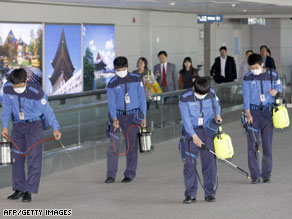
I've been following swine flu on CNN and the latest is that there are 787 global cases of confirmed H1N1 and places like South Korea are sanitizing airports after a single identified case.
Meanwhile, the CDC is tracking the number of cases in each state. As of May 3, there are 226 cases. This means that almost 1/3 of the confirmed cases are in the USA. Why is that a big deal? Because people from all over the world travel to and from the USA. We are a major international travel hub. As the summer approaches, we will see a rise of tourists and other travelers. New York now has 63 confirmed cases. Yesterday, NY had 50. If there's one US city that attracts international tourists, it's NYC. We're already in May and schools are about to enter summer break. College students will be traveling home. We're about to see a major surge in domestic travel as well.
Anthrax was a scare, but it isn't transmitted as easily as the flu. SARS was a really big scare (especially because I knew friends living in Hong Kong), but Hong Kong isn't the type of major international travel hub like the USA.
Here in the U.S., we have a large supply of anti-viral therapies like Tamiflu (oseltamivir) and Relenza (zanamivir). Do other countries have the supply like we do? How much do these anti-viral therapies impact the course of the disease? It's probably too early to know the answer to that question. However, it may not be unreasonable to think that anti-viral therapy may be one of the reasons why mortality in the U.S. hasn't been as high as Mexico (but I don't have any scientific evidence to support that statement).
Saturday, May 2, 2009
Is Swine Flu in Your State?
Have you seen the CDC chart that's tracking swine flu? People may think that the highest number of confirmed cases are in Texas. Wrong! New York already has 50 confirmed cases (as of May 2 at 11 am ET). Texas has 28 and California has 24. H1N1 is spreading rapidly. Every state that has a major metropolitan area will be on this chart within the next several days.
To view this scary chart, go here: http://www.cdc.gov/h1n1flu/
Image source: CDC
Friday, May 1, 2009
CDC and the H1N1
The CDC (Centers for Disease Control and Prevention) has released something titled, "Interim Guidance on Antiviral Recommendations for Patients with Confirmed or Suspected Swine Influenza A (H1N1) Virus Infection and Close Contacts."
If you're a healthcare professional who may be involved in the treatment of someone who has swine flu (or suspected swine flu), then you should read this and stay abreast on any updates the CDC releases. The misuse of antiviral therapies may lead to all sorts of problems ranging from drug shortages, drug resistance, and unnecessary adverse effects.
Subscribe to:
Posts (Atom)