Misuse and abuse of opioids has grown to be a serious public health concern about addiction, overdose, and death. REMS-compliant training is a critical component of the ER/LA Opioid Analgesics REMS program.
On July 9, 2012, the FDA approved a risk evaluation and mitigation strategy (REMS) for extended-release (ER) and long-acting (LA) opioid medications. The REMS introduces new safety measures to reduce risks and improve safe use of ER/LA opioids while continuing to provide access to these medications for patients in pain.
You can access free online REMS-compliant training on ER and LA opioids CME activities on QuantiaMD.

Showing posts with label REMS. Show all posts
Showing posts with label REMS. Show all posts
Sunday, July 6, 2014


Wednesday, July 18, 2012
FDA approves weight-management drug Qsymia with a REMS
Here's the press release about a new obesity drug Qsymia (pronounced kyoo-SIM-ee-uh):
FDA approves weight-management drug Qsymia
The U.S. Food and Drug Administration today approved Qsymia (phentermine and topiramate extended-release) as an addition to a reduced-calorie diet and exercise for chronic weight management.
The drug is approved for use in adults with a body mass index (BMI) of 30 or greater (obese) or adults with a BMI of 27 or greater (overweight) who have at least one weight-related condition such as high blood pressure (hypertension), type 2 diabetes, or high cholesterol (dyslipidemia).
Friday, March 25, 2011
FDA approves Yervoy (ipilimumab) to treat melanoma
FDA approves new treatment for a type of late-stage skin cancer
Melanoma patients lived longer with treatment
The U.S. Food and Drug Administration today approved Yervoy (ipilimumab) to treat patients with late-stage (metastatic) melanoma, the most dangerous type of skin cancer.
Melanoma is the leading cause of death from skin disease. An estimated 68,130 new cases of melanoma were diagnosed in the United States during 2010 and about 8,700 people died from the disease, according to the National Cancer Institute.
“Late-stage melanoma is devastating, with very few treatment options for patients, none of which previously prolonged a patient’s life,” said Richard Pazdur, M.D., director of the Office of Oncology Drug Products in the FDA’s Center for Drug Evaluation and Research. "Yervoy is the first therapy approved by the FDA to clearly demonstrate that patients with metastatic melanoma live longer by taking this treatment."
Thursday, October 7, 2010
PDR Network Delivers Six Million Drug Alerts & REMS
PDR Network Delivers Six Million Drug Alerts & REMS
Electronic Delivery of REMS Fulfills FDA Guidance
MONTVALE, NJ, [October 7, 2010] – PDR Network, already the largest distributor of FDA-approved drug information and Drug Alerts to U.S. prescribers, announced that this month it will surpass six million Drug Alerts and Risk Evaluation and Mitigation Strategies (“REMS”) program alerts delivered to prescribers. FDA-approved Drug-Alerts have been delivered electronically to prescribers by PDR Network’s Health Care Notification Network (HCNN) service since 2008.
REMS programs are becoming increasingly common, and often more complex, for both newly-approved drugs as well as those already on the market. Over 140 drugs now have REMS programs required by the FDA. In some instances the REMS consists largely of an FDA-approved medication guide while in other cases prescribers must take additional training to prescribe the drug. But in every case it is important for prescribers to know the details of the FDA-approved labels and REMS programs, and PDR Network provides this information directly to prescribers online.
Wednesday, September 15, 2010
Krystexxa (pegloticase) approved by the FDA for gout
The U.S. Food and Drug Administration approved Krystexxa (pegloticase) to treat the painful condition known as gout in adults who do not respond to or who cannot tolerate conventional therapy.
This drug is not your typical gout drug. Read on:
For patients with gout, the conventional therapy is to receive drugs that lower the amount of uric acid in the blood, as, for example, the xanthine oxidase inhibitors Zyloprim (allopurinol) and Uloric (febuxostat). Krystexxa is an enzyme that lowers uric acid levels by metabolizing it into a harmless chemical that is excreted in the urine. The drug is administered to patients every two weeks as an intravenous infusion.
Two six-month clinical trials of 212 total patients demonstrated that the drug lowered uric acid levels and reduced deposits of uric acid crystals in joints and soft tissue.
Since one out of every four patients in the clinical trials experienced a severe allergic reaction when receiving an infusion of Krystexxa, health care providers should dispense a corticosteroid and an antihistamine to their patients beforehand to minimize the risk of such a reaction. Other reactions during the clinical trials included gout flare, nausea, injection site bruising, irritation of the nasal passages, constipation, chest pain and vomiting.
Tuesday, February 9, 2010
PDR Network expands REMS services
 PDR “REMS- up”
Executive Team
Top Medical / Regulatory Experts Join PDR Network Management Team
(
Montvale,
NJ)
–
Feb. 9, 2010 –
The PDR Network, already the largest distributor of FDA-approved drug
information, Alerts and REMS programs to physicians, has added two top
regulatory and risk executives to its management
team and expanded its REMS and pharmaceutical risk offerings.
Christine Côté, MD,
has joined PDR Network as the Chief Medical Officer. Dr. Côté has over
24 years experience at Johnson & Johnson and Zeneca Pharmaceuticals,
where she held several senior regulatory, clinical and strategic
positions including Chief Scientific Officer for J&J’s Janssen
Pharmaceutica division. Also during her time at J&J, Dr. Côté was
directly involved with the creation of the Health Care Notification
Network, now operated by PDR Network, which sends drug Alerts and REMS
programs to U.S. physicians electronically, replacing paper
notifications and traditional Dear Doctor Letters.
John Loucks has
joined PDR Network’s senior management team as the Vice President of
Sales. Mr. Loucks was previously the Chief Customer Officer
for Relsys, the drug safety solutions company recently acquired by
Oracle Corporation. During his time at Relsys, Mr. Loucks assisted in
the development, sale and implementation of Relsys’ Argus Safety™,
which is the number one drug safety system used by pharmaceutical
manufacturers worldwide.
Dr Côté and Mr.
Loucks join the team at PDR Network as part of the expansion of
medication risk and REMS services that communicate directly with
all prescribing U.S. physicians. PDR Network is the largest distributor
of FDA-required REMS programs for pharmaceutical firms, having
delivered over three million REMS and
drug Alerts to physicians and other prescribers in the past two years.
For more information
about PDR Network, visit
www.pdrnetwork.com.
Friday, January 22, 2010
HCNN-PDR drug alert

IMPORTANT SAFETY INFORMATION
Regarding ACTEMRA® (tocilizumab)
The purpose of this letter is to inform you of important safety information for ACTEMRA® (tocilizumab), a new interleukin-6 (IL-6) receptor inhibitor that has been approved by the Food and Drug Administration (FDA) for the treatment of adult patients with moderately to severely active rheumatoid arthritis (RA) who have had an inadequate response to one or more tumor necrosis factor (TNF) antagonist therapies.
ACTEMRA targets IL-6. FDA has determined that a Risk Evaluation and Mitigation Strategy (REMS) is necessary for ACTEMRA to ensure that the benefits of the drug outweigh the potential risks of serious infections, gastrointestinal perforations, changes in liver function, decreases in peripheral neutrophil counts, decreases in platelet counts, elevations in lipid parameters in peripheral blood, demyelinating disorders and malignancies.
To read the full letter, click here.
Thursday, July 16, 2009
FDA Approves Onsolis (fentanyl buccal soluble film)

The FDA approved Onsolis (fentanyl buccal soluble film) with a Risk Evaluation and Mitigation Strategy (REMS). Fentanyl is the most "potent" opioid and is subject to abuse, misuse, and diversion.
Onsolis is in a class of drugs that deliver the potent opioid fentanyl through the mouth’s mucous membranes. Onsolis delivers fentanyl via an absorbable film that sticks to the inside of the cheek. The drug is indicated for the management of breakthrough pain in patients with cancer, ages 18 and older, who already use opioid pain medication around the clock and who need and are able to safely use high doses of an additional opioid medicine. Such patients are considered opioid tolerant because of their current opioid medication use. “Onsolis can provide strong pain relief to patients who are opioid tolerant. But for patients who are not opioid tolerant, it can lead to overdose, sudden serious breathing difficulties and death,” said Bob Rappaport, M.D., director, Division of Anesthesia, Analgesia and Rheumatology Products in the FDA’s Center for Drug Evaluation and Research (CDER). “For this reason, Onsolis should be prescribed only under the safeguards provided by the FDA-required REMS and by health care professionals knowledgeable about Onsolis and the use of potent opioid medications.”Glad to see that cancer patients now have another option to help them with pain control. Tolerance to opioids is a common problem. As you increase on dosage and give more opioids, the side effects (such as constipation) can become very problematic. Fortunately, there's a drug approved by the FDA for opioid-induced constipation or OIC. It's called Relistor (methylnaltrexone) and it's made by Wyeth.
As part of the REMS, Onsolis will only be available through a restricted distribution program called the FOCUS program. Under this program, only those prescribers, patients and pharmacies registered with the program will be able to prescribe, dispense, and receive Onsolis. The FOCUS program will provide training and educational materials to prescribers and pharmacy personnel, and a counseling call will be placed to patients prior to dispensing to ensure they have been adequately educated about the appropriate use of the drug. Prescription orders will be filled only by participating pharmacies that send the product directly to the patients’ homes.
Onsolis was approved with a boxed warning, which states that the medication should not be used for the management of migraines, dental pain, or postoperative pain or by patients who use opioids intermittently, or on an as-needed basis. It also warns that the drug should be kept out of the reach of children and should not be substituted for other fentanyl products.
In February, the FDA announced that it would require a REMS for a different class of opioids that offer long-acting and extended-release medication. The FDA has held a series of meetings with stakeholders, including a large public meeting, and also solicited written public comments to hear more about how to develop this REMS.
“The REMS for Onsolis was specifically tailored to that drug and should not be viewed as a model REMS for long-acting and extended-release opioid products,” said Douglas Throckmorton, M.D., deputy director of CDER. “Developing the comprehensive REMS for these other products is a complex undertaking. We will take the time necessary to review all of the public comments and will proceed in a deliberate manner toward the mutual goals of patient access and patient protection.”
Onsolis is manufactured by Aveva Drug Delivery Systems, Miramar, Fla., and marketed under license from BioDelivery Sciences International Inc. of Raleigh, N.C., by Meda Pharmaceuticals Inc., based in Somerset, N.J.
Tuesday, May 26, 2009
FDA Approves Samsca

Last week, the FDA approved Samsca (tolvaptan) for the treatment of hyponatremia (or low blood sodium levels). The topic of hyponatremia often confuses medical students because of the complex physiology involved in sodium regulation. You have hormones like ADH (antidiuretic hormone) affecting the kidney. Then you may get patients with mental illness who may also have primary (or psychogenic) polydipsia. These individuals drink so much water that their blood sodium level gets dangerously low.
Samsca is approved to treat hyponatremia associated with congestive heart failure, liver cirrhosis, and the syndrome of inappropriate antidiuretic hormone secretion (SIADH). What's also interesting is that the FDA is requiring a Risk Evaluation and Mitigation Strategy (REMS) that requires a patient Medication Guide be given out when the drug is dispensed. Why? Because Samsca comes with a boxed warning about the possibility of osmotic demyelination syndrome (ODS). Samsca is marketed by Otsuka Pharmaceuticals Co. Ltd., Tokyo, Japan.
Friday, May 1, 2009
2 FDA Alerts: Hydroxycut and Botox
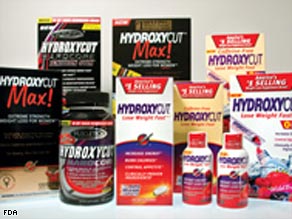
The FDA has recently released two different (unrelated) alerts:
- Botox - now has safety label changes, a boxed warning, and a Risk Evaluation and Mitigation Strategy (REMS).
- Hydroxycut - stop using any hydroxycut products by Iovate Health Sciences because of serious health problems.
Subscribe to:
Posts (Atom)