 Doctors around the world are sharing medical insights and discussing patient cases within the DocCheck Community. The "DocCheck Ask a Colleague" allows you to share a case, ask a colleague, or discuss a case. Learn more here.

Showing posts with label international health. Show all posts
Showing posts with label international health. Show all posts
Thursday, February 28, 2013
DocCheck "Ask a Colleague"
Doctors around the world are sharing medical insights and discussing patient cases within the DocCheck Community. The "DocCheck Ask a Colleague" allows you to share a case, ask a colleague, or discuss a case. Learn more here.


Monday, April 30, 2012
Discussing the international telemedicine market #ATA2012

A growing number of countries are using telemedicine to delivery care in areas that currently lack access. Hence, telemedicine is bridging a crucial gap to access, but there are regulatory challenges that telemedicine companies must understand that are unique to each country. Also, cultural factors must be addressed when telemedicine programs are being developed. Developing nations have needs and opportunities that are being addressed through the use of low-cost strategies that leverage mobile devices and ubiquitous wireless networks. As telemedicine solutions integrate with various electronic health records (EHRs), the issue of interoperability becomes another challenge that we must be ready to address. Right now, there are no international standards that are universally being applied to health information. So, global health information exchange is a significant challenge right now. Another major challenge surrounds the issue of sustainability. Who is paying for the telemedicine services in different countries? Does the government cover these types of health care costs? Or, are individual patients paying?
Wednesday, September 8, 2010
International #mHealth Perspectives
 Today was the first day of the 2nd International mHealth Networking Conference. It's been a full day of presentations and discussions about mobile health. As a physician champion for the HCPLive Network, I'm excited to blog about some of the highlights from this meeting. You can also follow updates about the mHealth Networking Conference on HCPLive.com.
 This afternoon, there was a presentation focusing on international perspectives on mHealth. The presentation was titled, "The Most Advanced Hospital in the World? Report from Severance Cardiovascular Hospital in Korea" by Byung-Chul Chang, MD. This hospital is part of the Yonsei University Health System (YUHS). Dr. Chang spoke about the digital infrastructure that's found in their hospital. He showed a marketing video that demonstrates how doctors in their hospital are using mobile PCs, smartphones, RFID, and other technologies. I love the idea of an automatic payment system that leverages a card (similar to a credit card) and an ATM-like machine in the hospital lobby.
Friday, March 5, 2010
Evolving role of the PHR and international health
 Cardiac patients are often told to carry a photocopy of their latest EKG (or ECG) when they travel. This way, if they happen to suffer chest discomfort and if they end up in an emergency room, they can quickly provide a copy of their latest EKG so that clinicians can compare that EKG to the current EKG.
Given that more and more patients are now using a digital personal health record or PHR, will this mean that we can simply keep digital copies of studies like an EKG or chest X-ray on web-based PHRs? What if you end up in a remote hospital that lacks Internet access? What if the ER doesn’t allow you to sit in front of a computer to retrieve your medical records?
Paper is nice, but what happens if you lose that piece of paper? Future travelers will probably always carry a laptop, tablet, netbook, or some other mobile computing device (maybe even an iPad) so that they can keep copies of their latest vital medical records on these mobile devices.
Monday, November 2, 2009
Microsoft HealthVault in Thailand

Microsoft's personal health record (PHR) service HealthVault is going to Bumrungrad International Hospital in Bangkok, Thailand. I've never been to Thailand but I know some people who moved to live there a few years ago. Here's a snippet from InformationWeek about HealthVault in Thailand:
With HealthVault, international patients who receive treatment at Bumrungrad will be able to access and share their medical records via the Web once they're back home, promoting continuity of care. The records are available free to Bumrungrad's approximately 420,000 international patients as well as to those living locally.Sounds like some exciting developments in the international PHR space. Since we're all connected by the Internet, it should be relatively easy to access health records from anywhere in the world. I'm sure we'll be hearing some interesting things about Google Health in the near future as they make inroads in the PHR space.
Bumrungrad has 1.5 million patients, and about 45,000 of those annually are Americans who travel to Thailand for healthcare services that are too expensive in the U.S., or aren't readily available to them if they're living outside the U.S. as expatriates.
Tuesday, October 27, 2009
The International Cancer Corps (ICC)

If you're an ASCO (American Society of Clinical Oncology) member, you may like to know that ASCO has partnered with Health Volunteers Overseas (HVO) to launch a new humanitarian program called the International Cancer Corps (ICC). There's a tremendous opportunity to help developing countries provide better cancer care.
To learn more about some of these volunteering opportunities, visit: www.asco.org/volunteer
Wednesday, August 19, 2009
Are you familiar with the World Diabetes Foundation?

I was reminded today that some pharmaceutical companies do invest in global public health initiatives. Novo Nordisk established the World Diabetes Foundation in 2002 and this foundation has funded projects focusing on diabetes awareness, education, and capacity-building in the developing world. This foundation focuses on these areas:
- Awareness of diabetes
- Prevention of diabetes and its complications
- Education and training of patients and health care professionals
- Enhancement of detection, treatment and monitoring of diabetes
- The establishment of the World Diabetes Foundation (WDF) was announced by its founding father Novo Nordisk A/S on World Diabetes Day 2002.
- The World Diabetes Foundation has funded 208 projects to date, covering 87 countries.
- The Foundation is a independent and non-profit foundation governed by the Danish Act on Foundations.
To visit the World Diabetes Foundation, click on this link: http://www.worlddiabetesfoundation.org
(You may wish to make a donation while you're there)
Thursday, April 23, 2009
Bioengineering Mosquitoes to Cure Malaria
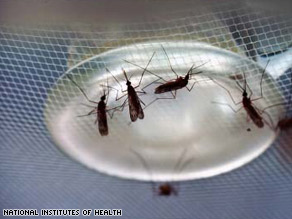
I hate mosquitoes. I love to hike and camp, but I hate using bug spray to keep these nasty pests away. Well, scientists are growing, or actually I should say they are bioengineering mosquitoes to create a vaccine against malaria. If the vaccine is successful, then I think we'll have a really serious global population problem on our hands. It may be strange to think that malaria actually controls the world's population in certain areas of the globe. If a vaccine eradicated malaria the same way a vaccine eradicated smallpox, then the who knows what would happen to the world's population. Maybe countries may need to enforce one-child policies that are found in China. Who knows? But this would lead to a very interesting public health ethical dilemma.
Monday, August 18, 2008
International Health on the SDN

The Student Doctor Network (SDN) has a nice story about International Health. Have you ever had the opportunity to practice medicine in a different country? It can be quite an experience. Many years ago, I had the opportunity to practice medicine briefly in Mexico and Honduras. I still have some great memories from those international experiences. The public health needs in other countries can vary so much compared to the United States. A friend of mine works for the CDC and is currently based in China. Several other friends are working as primary care physicians in a private practice settings in China.
Subscribe to:
Posts (Atom)