Get ready for the 2011 Public Health Informatics conference. This year, you can attend the virtual conference for free!
The annual conference for the public health informatics community will be held in Atlanta, Georgia, August 21–August 24, 2011 at the Hyatt Regency in downtown Atlanta.
The theme this year is Engaging, Empowering, Evolving…Together, and we hope you'll join us as the best of the public health and health informatics communities meet in one place to invest in the future of public health informatics and every discipline it may touch. The National Association of County and City Health Officials (NACCHO) will co-sponsor this event.

Showing posts with label epidemiology. Show all posts
Showing posts with label epidemiology. Show all posts
Monday, August 22, 2011


Tuesday, November 10, 2009
Public health should be renamed population health

Recently, I've been thinking about population health. Then, I began to consider the term public health. Why do we call it public health? Are we trying to differentiate it from private health? (what is private health anyways? Our health is private and confidential, so what's public about health?)
I think we're slowly recognizing that public health is really about population health. I'm not simply referring to epidemiology or biostatistics. We're looking at the forest instead of the trees. Instead of focusing on individual health, we're looking at the population. Macro-health vs. micro-health. A few years ago, David Kindig, MD, PhD and Greg Stoddart, PhD asked the question, "What Is Population Health?" They noted that:
Population health is a relatively new term that has not yet been precisely defined. Is it a concept of health or a field of study of health determinants?I wonder if someday in the future, my MPH will mean "Master of Population Health" instead of "Public Health." I'll need a new diploma.
Friday, May 8, 2009
Is it Dangerous to Live Next to Power Lines?

I've been asked this question by tons of people. My honest answer is that "I don't really know." We know that some people have a difficult time selling their home because they have a power line in their backyard (well, maybe not literally in their backyard).
Do you live next to a power line?
These types of environmental and public health questions are very difficult to answer. You're certainly not going to conduct a randomized control trial (RCT) to determine whether living next to power lines poses any health hazards. The best you'll do is to collect some retrospective data from samples of patients who develop certain health ailments. Or, you may follow a cohort longitudinally, but that may take a very long time.
Here's something interesting: Researchers (Wartenberg et al.) recently found that people living within 2000 ft from high-voltage electric power transmission lines (HVTL) were more likely to be white, of higher income, more educated, home owners, and exposed to magnetic fields. This was published in the Journal of Exposure Science and Environmental Epidemiology.
Interesting? So, who's most likely to live by power lines? According to this study (which was conducted in New York), the answer seems to suggest: upper-class Caucasian radiologists homeowners who are always using their cell phones (don't get me started on the cell phone radiation issue).
A Swiss study (Huss et al.) found that people who lived near electrical power lines had higher odds of developing Alzheimer's disease and senile dementia. These types of epidemiological studies may not prove causation, but they do suggest an association. This was published recently in the American Journal of Epidemiology.
Wednesday, April 29, 2009
Ordered Some N95 Masks Today

 Yes, I ordered some N95 face masks from Amazon.com for my relatives who live in Houston, Texas. They're all worried about swine flu and I can understand their concern. They should probably also stock up on hand soap and antibacterial wipes and gels.
Swine flu is getting very serious and even Obama is urging schools to close their doors if they suspect any illness (what type of school never has a sick child in attendance?). What will happen to summer travel? The US economy is struggling as it is and if travel is restricted or limited, then some business will not be able to survive.
Saturday, April 25, 2009
Swine Flu Getting Serious?
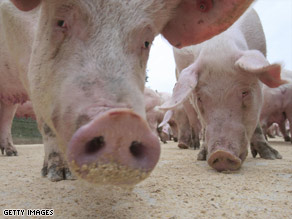
CNN is reporting that the WHO is worried about the growing number of swine flu cases. There have been eight cases of human infection in the U.S. Six of the U.S. cases were in California and two in Texas. More than 1000 people are infected in Mexico and 68 people have died. How worried should we be? I think we need to stay tuned for updates from the CDC. Thanks to CNN for the image.
Subscribe to:
Posts (Atom)