Showing posts with label clopidogrel. Show all posts

Friday, March 12, 2010

New boxed warning for Plavix (clopidogrel)

FDA Announces New Boxed Warning on Plavix
Alerts patients, health care professionals to potential for reduced effectiveness

The U.S. Food and Drug Administration today added a boxed warning to the anti-blood clotting drug Plavix (clopidogrel), alerting patients and health care professionals that the drug can be less effective in people who cannot metabolize the drug to convert it to its active form.

Plavix reduces the risk of heart attack, unstable angina, stroke, and cardiovascular death in patients with cardiovascular disease by making platelets less likely to form blood clots. Plavix does not have its anti-platelet effects until it is metabolized into its active form by the liver enzyme, CYP2C19.

People who have reduced functioning of their CYP2C19 liver enzyme cannot effectively convert Plavix to its active form. As a result, Plavix may be less effective in altering platelet activity in those people. These “poor metabolizers” may not receive the full benefit of Plavix treatment and may remain at risk for heart attack, stroke, and cardiovascular death.

Thursday, November 19, 2009

New warning on Plavix (from the FDA)


You've probably heard the news already. You've probably seen the FDA press release. Plavix combined with Prilosec/Prilosec OTC significantly reduces the anti-platelet efficacy of Plavix. For that matter, Plavix combined with any other drugs that inhibit the CYP2C19 enzyme will have significant drug-drug interactions.

Plavix is one of those pills that people take and we don't typically measure or monitor whether the drug is working. It's not like Coumadin (warfarin) where we constantly measure an INR to make sure that your levels are therapeutic. We don't check for peaks of troughs when you're on Plavix. However, perhaps this will change as advances in medical technology make it easier for clinicians to monitor platelet activity in cardiac patients who are taking anti-platelet therapy.

To read the recent FDA news regarding Plavix and Prilosec, click here.

Friday, July 10, 2009

FDA finally approves Effient (prasugrel)


The FDA has finally approved Effient (prasugrel), a thienopyridine that is similar to Plavix (clopidogrel). In fact, prasugrel has been compared to clopidogrel. The TRITON-TIMI 38 study (comparing prasugrel against clopidogrel) was published in the New England Journal of Medicine (NEJM) back in November 2007! That's not a typo. 2007. The FDA wanted more safety data (which is why they launched the TRILOGY ACS study). I guess the FDA got what they needed. Here are the details straight from the FDA (with a few of my comments):

FDA Approves Effient to Reduce the Risk of Heart Attack in Angioplasty Patients
The U.S. Food and Drug Administration has approved the blood-thinning drug Effient tablets (prasugrel) to reduce the risk of blood clots from forming in patients who undergo angioplasty, a common procedure to unblock a clogged coronary artery. (it's about time, isn't it? The TRITON-TIMI 38 study came out in November, 2007! OK, you wanted more safety data because of bleeding. Fine.)

During an angioplasty, a balloon is used to open the artery that has been narrowed by atherosclerotic plaque. Often, a tiny wire mesh scaffold (stent) is inserted into the blood vessel to help keep the artery open after the procedure. Platelets in the blood can clump around the procedure site, causing clots that can lead to heart attack, stroke, and death.

Effient (prasugrel) was studied in a 13,608-patient trial (this is the TRITON-TIMI 38 study) comparing it to the blood-thinning drug, Plavix (clopidogrel), in patients with a threatened heart attack or an actual heart attack who were about to undergo angioplasty.

The fraction of patients who had subsequent non-fatal heart attacks was reduced from 9.1 percent in patients who received Plavix to 7.0 percent in patients who received Effient.While the numbers of deaths and strokes were similar with both drugs, patients with a history of stroke were more likely to have another stroke while taking Effient. In addition, there was a greater risk of significant, sometimes fatal bleeding seen in patients who took Effient. (So, Effient may be more effective than Plavix in certain patients, but it also appears to have a higher risk for bleeding)

“Effient offers physicians an alternative treatment for preventing dangerous blood clots from forming and causing a heart attack or stroke during or after an angioplasty procedure,” said John Jenkins, M.D., director of the Office of New Drugs, in the FDA’s Center for Drug Evaluation and Research.“Physicians must carefully weigh the potential benefits and risks of Effient as they decide which patients should receive the drug.” (in other words, doctors now have to choose between Plavix vs. Effient. How are they to make this decision? Bleeding risk? Anti-platelet resistance?)

The drug’s labeling will include a boxed warning alerting physicians that the drug can cause significant, sometimes fatal, bleeding. The drug should not be used in patients with active pathological bleeding, a history of mini-strokes (transient ischemic attacks) or stroke, or urgent need for surgery, including coronary artery bypass graft surgery. (we all know that blood thinners can cause serious bleeding, so this is plain common sense)
So, Effient is an alternative to Plavix. Now, the big question now is: who should get Effient and who should get Plavix? If you need a thienopyridine, which would you prefer? I'm not going to get started about anti-platelet resistance on this blog post.
  • Effient is manufactured by Eli Lilly and Company of Indianapolis, in partnership with Tokyo-based Daiichi Sankyo Ltd.
  • Plavix is marketed by a sanofi-aventis U.S. LLC, Bristol-Myers Squibb/Sanofi Pharmaceuticals Partnership.
There are many other acute coronary syndrome (ACS) drugs on the horizon, including thrombin receptor antagonists (TRAs) like SCH 530348 and novel anti-platelet drugs like cangrelor and AZD6104. I wonder if (or when) we'll see these new agents get approved.

Tuesday, May 19, 2009

Risk of Stroke or Bleed?


Would you rather risk a stroke or a bleed? A massive hemorrhage? Well, if you put it that way, then maybe it's too obvious.

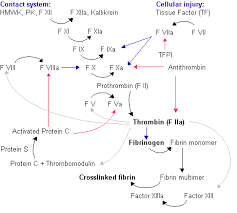
When I was in medical school, the standard treatment for atrial fibrillation anticoagulation was either warfarin (Coumadin) or aspirin (for those who can't take warfarin or for those who have a relatively low risk for embolic stroke). Warfarin acts on the coagulation pathway by inhibiting factor VII. Aspirin acts on platelets - and doesn't act on the coagulation cascade. (I realize that I may be over-simplifying this, but this is a blog and not a scientific textbook so I hope you'll bear with me). Plavix (clopidogrel) also acts on platelets and doesn't act on the coagulation cascade. Does it make sense to combine asprin and Plavix to prevent embolic stroke in patients with atrial fibrillation? In medical school, I would have answered "no" because neither aspirin nor Plavix work on the coagulation cascade. They don't interfere with fibrin, thrombinogen, Protein C, or thrombin. So

A recent edition of the NEJM has an article titled, "Effect of Clopidogrel Added to Aspirin in Patients with Atrial Fibrillation." The ACTIVE Investigators wanted to know what would happen if you add Plavix to asprin in patients who have atrial fibrillation. Here's what they found (in a nutshell): "In patients with atrial fibrillation for whom vitamin K–antagonist therapy (they're referring to warfarin) was unsuitable, the addition of clopidogrel (Plavix) to aspirin reduced the risk of major vascular events, especially stroke, and increased the risk of major hemorrhage."

So, would you rather risk a stroke or risk major hemorrhage?

Monday, February 23, 2009

The European Commission Approves Efient (prasugrel

No, not Effient (which is the proposed US tradename). Efient (prasugrel) has been approved in Europe for acute coronary syndrome (ACS) patients undergoing PCI. The annoucement was made by Daiichi SankyoCompany, Limited and Eli Lilly and Company.

Two of the major prasugrel studies are:
  • TRITON–TIMI 38 (Trial to Assess Improvement in Therapeutic Outcomes by Optimizing Platelet Inhibition with Prasugrel–Thrombolysis in Myocardial Infarction), and
  • TRILOGY ACS (TaRgeted platelet Inhibition to cLarify the Optimal strateGy to medicallY manage Acute Coronary Syndromes),
Prasugrel is a dihydropyridine that is currently under FDA review. The other dihydropyridine you're probably familiar with is Plavix (clopidogrel) which is marketed by sanofi-aventis U.S. LLC and Bristol-Myers Squibb/Sanofi Pharmaceuticals Partnership.