Collaboration to focus on development of a low-cost, high-throughput, long read, high density DNA sequencing system.
London, United Kingdom, Nov 01, 2010 - DNA Electronics, a fabless semiconductor provider of solutions for real-time DNA and RNA analysis, announced today that it has entered a partnership with 454 Life Sciences, a Roche Company. The collaboration will focus on the development of a low-cost, high-throughput, long read, high density DNA sequencing system. As part of the agreement, DNA Electronics has signed a non-exclusive licence to provide relevant IP from its proprietary semiconductor technology portfolio to Roche. This technology which enables sensitive detection of nucleotide incorporation during sequencing will build on 454 Life Sciences’ current pyrosequencing-based platform. The collaboration leverages DNA Electronics’ unique knowledge of semiconductor design and expertise in pH-mediated detection of nucleotide insertions with 454 Life Sciences’ long read sequencing chemistry to produce a seamless evolution from optical detection to low-cost, highly scalable electrochemical detection.

Showing posts with label DNA. Show all posts
Showing posts with label DNA. Show all posts
Monday, November 1, 2010


Friday, April 23, 2010
National DNA Day!

Celebrate the completion of the Human Genome Project and learn more about genetics and genomics on National DNA Day, April 23rd.
National DNA Day is a special day when teachers, students, and the public can learn more about genetics and genomics. The National Human Genome Research Institute (NHGRI) at the National Institutes of Health has sponsored DNA Day for the past seven years, in honor of the completion of the Human Genome Project in April 2003 and of Watson and Crick’s discovery of the double helix structure of DNA.Learn more here: http://www.genome.gov/DNAday/
This year, DNA Day will be celebrated on Friday, April 23rd. On this day and throughout April, researchers from across the country will visit dozens of high schools to talk with students and answer questions about genetics. This year, NHGRI is focusing on the District of Columbia and the surrounding regions. CDC works with NHGRI on DNA Day activities by giving presentations at schools in Georgia.
Wednesday, October 14, 2009
The power of DNA evidence even after 19 years
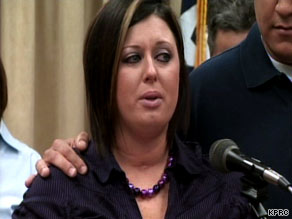 According to this story on CNN, a suspect has been arrested in the 1990 abduction and attempted murder of an 8-year-old Texas girl. DNA evidence has led to the arrest of Dennis Earl Bradford, a 40-year-old welder in Little Rock, Arkansas. The victim, Jennifer Schuett, went public with her story in hopes of someday bringing her attacker to justice.
The power of DNA evidence will grow as advances in science and technology improve our ability to use DNA evidence. We're constantly shedding DNA wherever we go. Our DNA fingerprint is everywhere and that's something that we can't erase.
My hope is that as the public becomes more educated about the power of DNA evidence, criminals will be get deterred. My heart goes out to Jennifer Schuett who had the courage to stand up and go public with her story. I admire her courage and hope that others may do the same so that the world may become a safer place.
Wednesday, September 16, 2009
Will DNA evidence reveal Le's killer?
 The story about Annie Le, a Yale student who has killed, is all over the news. Now, CNN is reporting that one man (a Yale employee) is in custody. However, no arrests have been made yet.
Will DNA evidence reveal Le's killer? Due to the sensitive nature of this ongoing investigation, very little information has been released to the public. We know that her body was found in a medical research building. We also know that there were multiple surveillance cameras. As crime scene investigators work on solving this mystery, let's hope that this comes to an end quickly. On TV's CSI, the killer always seems to confess at the end of the show. I hope that we will see that type of closure for the Le family as well.
Wednesday, August 5, 2009
DNA testing in children, talents, and privacy in China
In China, scientists (probably along with some government officials) are performing genetic tests in young kids to identify skills and talents by analyzing their DNA. That's right, no personal privacy issues here. Submit a DNA sample to see what talents your parents should cultivate. Is this ethical? This is a fascinating video.
Saturday, March 29, 2008
Home Genetic Testing

At-home paternity DNA testing is available. What will be next? Huntington's disease testing? BRCA testing for breast and other cancers?
Many patients do not understand the full implications of genetic testing results. These tests never have 100% sensitivity or specificity. Therefore, false results may occur. However, if people can purchase such genetic tests online or at a local pharmacy, many will want to use them without receiving proper guidance. Genetic counseling is such an integral part of the testing process. This will be lacking if patients are doing the tests on their own.
Subscribe to:
Posts (Atom)