We now have a new class of oral anticoagulation medications on the market. Here's the news from the FDA:
The U.S. Food and Drug Administration today approved Pradaxa capsules (dabigatran etexilate) for the prevention of stroke and blood clots in patients with abnormal heart rhythm (atrial fibrillation).
Pradaxa is an anticoagulant that acts by inhibiting thrombin, an enzyme in the blood that is involved in blood clotting. The safety and efficacy of Pradaxa were studied in a clinical trial comparing Pradaxa with the anticoagulant warfarin. In the trial, patients taking Pradaxa had fewer strokes than those who took warfarin.
Pradaxa, manufactured by Boehringer Ingelheim Pharmaceuticals Inc. of Ridgefield, Conn., will be available in 75 milligram and 150 milligram capsules.
Read more here.

Showing posts with label atrial fibrillation. Show all posts
Showing posts with label atrial fibrillation. Show all posts
Tuesday, October 19, 2010


Friday, September 24, 2010
From to ximelagatran to dabigatran - how far have we come?
I still remember the days when people thought ximelagatran was going to change the world of anticoagulation. The days of the Coumadin (warfarin) clinics seemed numbered. People who would require frequent INR checks would no longer have to get poked with needles. They could eat all the green vegetables they desire. They would no longer take rat poison. Then, the sad news about ximelagatran hit the news. Ximelagatran (proposed trade name Exanta) was not going to be approved by the FDA because of liver toxicity. That was 2006.
Fast forward now to 2010 and we see that the FDA advisory committee (not the FDA, but the FDA advisory committee) unanimously today recommended the approval of dabigatran. This means that the FDA will probably approve dabigatran in the near future, but we still need to wait and see. Meanwhile, a host of other new anticoagulant drugs are waiting in line.
So what are these new oral anticoagulants? Let's see what Wikipedia has to say:
Physicians will need to be more familiar with the pharmacological profiles (half-life, interactions, etc.) as they choose among the myriad of available agents when they're treating patients with atrial fibrillation, DVT, or PE. Hospitalized patients at risk for DVT may no longer need to suffer from multiple injections if they simply need to take a pill. These emerging agents may also be used for patients who have artificial heart valves, those who have other types of hypercoagulable disorders, and more.
Back in 2006, we thought we were going to see a revolution in anticoagulation management, but it didn't happen. Now, in 2010, it appears like we may truly be looking at a new era.
Fast forward now to 2010 and we see that the FDA advisory committee (not the FDA, but the FDA advisory committee) unanimously today recommended the approval of dabigatran. This means that the FDA will probably approve dabigatran in the near future, but we still need to wait and see. Meanwhile, a host of other new anticoagulant drugs are waiting in line.
So what are these new oral anticoagulants? Let's see what Wikipedia has to say:
- Direct thrombin inhibitors (DTIs) are a class of medication that act as anticoagulants (delaying blood clotting) by directly inhibiting the enzyme thrombin. Agents in the pipeline include: dabigatran, melagatran (and its prodrug ximelagatran), and others.
- Direct factor Xa inhibitors ('xabans') are a class of antithrombotics which act directly upon Factor X in the coagulation cascade, without using antithrombin as a mediator. Agents in the pipeline include: rivaroxaban, apixaban, edoxaban, otamixaban, and others.
Physicians will need to be more familiar with the pharmacological profiles (half-life, interactions, etc.) as they choose among the myriad of available agents when they're treating patients with atrial fibrillation, DVT, or PE. Hospitalized patients at risk for DVT may no longer need to suffer from multiple injections if they simply need to take a pill. These emerging agents may also be used for patients who have artificial heart valves, those who have other types of hypercoagulable disorders, and more.
Back in 2006, we thought we were going to see a revolution in anticoagulation management, but it didn't happen. Now, in 2010, it appears like we may truly be looking at a new era.
Wednesday, March 24, 2010
Reflecting on treating patients with atrial fibrillation in the hospital
 It seems only like yesterday when I was titrating Cardizem drips and adjusting heparin infusions to treat patients who were admitted to the hospital for atrial fibrillation. Now, we have new drugs like dronedarone (Multaq or SR33589) and more patients seem to be undergoing ablation. I often wonder how atrial fibrillation patients will be treated in the future. Will they even get admitted, or will they get managed as an outpatient? We'll soon have novel oral anticoagulants that don't require any INR monitoring. We'll soon have highly effective drugs to treat coronary heart disease. We'll be seeing new antiplatelet agents that utilize novel mechanisms of actions.
 Sometimes, it's hard to believe how rapidly medicine is evolving. How will afib get treated in 10 years? 20 years? The standard of care will certainly evolve as new treatments emerge and as older therapies potentially get replaced with newer alternatives.
Thursday, July 2, 2009
FDA Approves Multaq (dronedarone) to Treat Heart Rhythm Disorder

This is straight from the FDA RSS feed:
FDA Approves Multaq to Treat Heart Rhythm Disorder.
The U.S. Food and Drug Administration has approved Multaq tablets (dronedarone) to help maintain normal heart rhythms in patients with a history of atrial fibrillation or atrial flutter (heart rhythm disorders). The drug is approved to be used in patients whose hearts have returned to normal rhythm or who will undergo drug or electric-shock treatment to restore a normal heart beat.
Multaq may cause critical adverse reactions, including death, in patients with recent severe heart failure. The drug’s label will contain a boxed warning, the FDA’s strongest warning, cautioning that the drug should not be used in severe heart failure patients.
“Multaq represents a therapeutic innovation for treatment of the heart rhythm disorder of atrial fibrillation,” said Norman Stockbridge, M.D., Ph.D., director of the Division of Cardiovascular and Renal Products in the FDA’s Center for Drug Evaluation and Research.
In a multinational clinical trial with more than 4,600 patients, Multaq reduced cardiovascular hospitalization or death from any cause by 24 percent, when compared with an inactive pill (placebo). Most of that effect represents reduced hospitalizations, especially hospitalizations related to atrial fibrillation. Atrial fibrillation and atrial flutter cause the heart to beat abnormally fast and sometimes prevent blood from being properly pumped out of the heart.
The most common adverse reactions reported by patients in clinical trials were diarrhea, nausea, vomiting, fatigue and loss of strength. Multaq is manufactured by Paris-based sanofi-aventis.
So, let's talk about this for a few minutes. Dronedarone is a brand new drug and it may replace the use of amiodarone in many patients who have afib. Atrial fibrillation is a common condition that you get to manage in the hospital setting. It's not a lot of fun if you have to run around to titrate Cardizem drips all day. Amiodarone is associated with some significant toxicities, including pulmonary toxicity leading to interstitial pneumonitis and other lung problems. It's great to see that we have other alternatives for patients with afib. Speaking of afib, medical students often like to use a mnemonic to help them remember the different causes of afib:
PIRATES:
- Pulmonary: PE, COPD
- Iatrogenic
- Rheumatic heart: mirtral regurgitation
- Atherosclerotic: MI, CAD
- Thyroid: hyperthyroid
- Endocarditis
- Sick sinus syndrome
Tuesday, May 19, 2009
Risk of Stroke or Bleed?
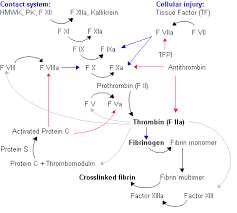
Would you rather risk a stroke or a bleed? A massive hemorrhage? Well, if you put it that way, then maybe it's too obvious.
When I was in medical school, the standard treatment for atrial fibrillation anticoagulation was either warfarin (Coumadin) or aspirin (for those who can't take warfarin or for those who have a relatively low risk for embolic stroke). Warfarin acts on the coagulation pathway by inhibiting factor VII. Aspirin acts on platelets - and doesn't act on the coagulation cascade. (I realize that I may be over-simplifying this, but this is a blog and not a scientific textbook so I hope you'll bear with me). Plavix (clopidogrel) also acts on platelets and doesn't act on the coagulation cascade. Does it make sense to combine asprin and Plavix to prevent embolic stroke in patients with atrial fibrillation? In medical school, I would have answered "no" because neither aspirin nor Plavix work on the coagulation cascade. They don't interfere with fibrin, thrombinogen, Protein C, or thrombin. So
A recent edition of the NEJM has an article titled, "Effect of Clopidogrel Added to Aspirin in Patients with Atrial Fibrillation." The ACTIVE Investigators wanted to know what would happen if you add Plavix to asprin in patients who have atrial fibrillation. Here's what they found (in a nutshell): "In patients with atrial fibrillation for whom vitamin K–antagonist therapy (they're referring to warfarin) was unsuitable, the addition of clopidogrel (Plavix) to aspirin reduced the risk of major vascular events, especially stroke, and increased the risk of major hemorrhage."
So, would you rather risk a stroke or risk major hemorrhage?
Subscribe to:
Posts (Atom)